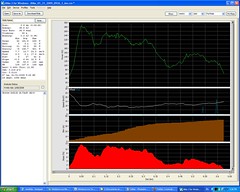
Did this a few months ago, but in an idle moment thought I'd post it now.... part of my plan to run my ibike wattmeter over all the local hills around Gosford, NSW.
The iBike calculates Watts from changes in speed, altitude (via a barometer) and acceleration. Whilst the numbers aren't large (I'm not Lance Armstrong) It gives me some way of baselining my training and working forward.
These aren't necessarily my best rides, highest speeds or biggest Wattage - just representative screenshots to give you an idea of hill slope and shape. If you don't have this sort of equipment you may find it interesting or useful.
Monday, April 06, 2009
Thursday, March 12, 2009
Raw vegan #cycling on 30 bananas a day... and training with Oscar Pereiro
A radical guy fueled with a radical raw vegan diet... and plenty of cycling: Adelaide's Harley Johnson. On a bamboo bike, too.
Wednesday, March 11, 2009
In-form Contador loses team in Paris-Nice boilover
So where did the Astana team go? There one moment, gone the next. Paris-Nice has been enlightening. Contador's skill, luck and good form won him the short TT section and the lead, much to the annoyance of the prologue specialists, but now his team has gone missing when the heat was on. Still, losing a minute is not the end of the world, it just puts him back where he probably should have been.
Once Rabobank hit the front Contador was in the fourth group on the road. He knew he had to do something. "I saw I had no teammates. The situation was very difficult, but I saw there was a short steep slope coming up and I accelerated." Contador looked good on the uphill, but closing the gap proved to be hard. He received some help from Christophe Moreau (Agritubel) to reach the group ahead. "This was the only possibility for me to save the race," Contador said.
I am guessing that Astana will get their act together in May and July. But there are some quietly good achievers steadily working to put roadblocks in the path of Armstrong, Contador and Co. Should be interesting.
Once Rabobank hit the front Contador was in the fourth group on the road. He knew he had to do something. "I saw I had no teammates. The situation was very difficult, but I saw there was a short steep slope coming up and I accelerated." Contador looked good on the uphill, but closing the gap proved to be hard. He received some help from Christophe Moreau (Agritubel) to reach the group ahead. "This was the only possibility for me to save the race," Contador said.
I am guessing that Astana will get their act together in May and July. But there are some quietly good achievers steadily working to put roadblocks in the path of Armstrong, Contador and Co. Should be interesting.


Monday, March 09, 2009
Graeme Brown wins again in Vuelta Murcia
Good to see Graeme Brown has sorted out his bike problems, or handling issues or whatever they were - you may recall him pulling his foot/getting baulked/breaking something in the finale of the Tour Down Under. He is obviously flying right now... and Rabo teammate Menchov won overall.
Thursday, March 05, 2009
Nice result for Graeme Brown at Vuelta Murcia
Seems like yesterday Brownie was the guy we all loved to hate, careening between riders in the sprint... now he's an old hand, almost a steadying influence... almost. Anyway, a nice stage win, beating an NZer in the process ;-)
Stage 1 - March 4: San Pedro del Pinatar - Lorca, 192.3km
Results 1 Graeme Brown (Aus) Rabobank 5.06.37 (37.63 km/h)
2 Greg Henderson (NZl) Team Columbia - High Road
3 Rubén Pérez (Spa) Euskaltel - Euskadi
4 Mathew Goss (Aus) Team Saxo Bank
5 Tom Leezer (Ned) Rabobank
6 Luca Paolini (Ita) Acqua e Sapone
7 Mathieu Drujon (Fra) Caisse d'Epargne
8 Luis Pasamontes (Spa) Caisse d'Epargne
9 David Herrero (Spa) Xacobeo Galicia
10 David Calatayud (Spa) Spanish National Team
Stage 1 - March 4: San Pedro del Pinatar - Lorca, 192.3km
Results 1 Graeme Brown (Aus) Rabobank 5.06.37 (37.63 km/h)
2 Greg Henderson (NZl) Team Columbia - High Road
3 Rubén Pérez (Spa) Euskaltel - Euskadi
4 Mathew Goss (Aus) Team Saxo Bank
5 Tom Leezer (Ned) Rabobank
6 Luca Paolini (Ita) Acqua e Sapone
7 Mathieu Drujon (Fra) Caisse d'Epargne
8 Luis Pasamontes (Spa) Caisse d'Epargne
9 David Herrero (Spa) Xacobeo Galicia
10 David Calatayud (Spa) Spanish National Team
Saturday, February 28, 2009
Join your own Open Source-style pro cycling team #cycling
Not such a new idea for pro cycling fans as is made out on the Crowdriders site, but a good idea nonetheless that (admittedly) takes the fan-as-owner idea a step further than before, where the crowd will (in theory) manage the pro cycling team as well as provide sponsorship (or capital, if you prefer). That should be interesting - 40,000 people voting on what to do with the cash raised! Basically if enough people get together and raise enough money they'll sign up riders and start a UCI-registered team. It's certainly not impossible, but others have tried to crowd-source and failed. Especially tricky will be getting the management side right - balancing the "democracy" that is promised for the crowd against the professional management and governance that is required. What if the majority want to do something crazy, or risky, or just sub-optimal? What if the guy starting this idea off is not the best guy to run the show yet remains at the epicentre just because he, umm, started it? Who will tell him that he's just one voice and what will he do - change the rules? I guess that will be explored in the fullness of time.
For a previous take on a subscription-based sponsorship of a cycling team, check out David McKenzie and iTeamNova
For a previous take on a subscription-based sponsorship of a cycling team, check out David McKenzie and iTeamNova
Tuesday, February 24, 2009
Tackling your first bike race - the criterium
First up, this is cycling, not football - no tackling required, thank goodness. In fact I've "tackled" this subject a few times, including right here. Crits are short, sharp races run at higher speeds than road races, usually with more corners and fewer hills, around a short course. The skill and fitness levels are high but endurance is less than a longer road race.
The essentials go a bit like this:
1. For a criterium you need a road bike. One with curvy 'dropped' handlebars and a pair of brakes will do - yes, you need to use the back brake too!
2. You need a bike with 2 lightish but stiff wheels, as flexy wheels in tight corners are not good as they feel soft and squishy and put you off
3. The bike itself could be around 8 or 9 kg in weight but extra kilos on the bike are not that much of a problem as crits are usually pretty flat. Light wheels will assist your acceleration more than a light bike. In any case you shouldn't stress about the bike. Your fitness will matter more
4. Having said that, the bike should be well maintained and unlikely to break under load!
5. Remove extraneous objects before the race - like streamers, plastic gear guards, bells, toolkits, books, magazines - and keep 'em for later
6. Pump up the tyres. 100psi sounds good but whatever you see written on the tyre will be a better guide. A harder tyre is a faster tyre, within limits (don't over-inflate as that may be dangerous, especially if the tyre blows off the rim!)
7. Join a bike club and get a racing licence. In Australia it's around $200 a year but varies with each club and your age. You get 3rd party insurance with that and a cool licence to prove you are a racer. Consider private health insurance as falling off at speed may be costly
8. Crits go round and round so you'll pass the pits several times. If you puncture (or have a 'mechanical') you will be allowed 'a lap out' but unless you are fabulously prepared and have a buddy following you with spare wheels it's unlikely you'll be able to take advantage of that in your early races. You can often leave spares at the start line anyway, just let someone know to watch 'em, in case they 'walk'. You won't get a lap out if you have reached the final lap, btw, you'll have to just watch - obey the race judge (the 'commissaire') in any case
9. Assuming you have followed my earlier advice and have trained at least enough to have sufficient endurance for the event in question, arrive at the racing venue with plenty of time in hand (30mins minimum, preferably an hour)
10. If you haven't already done so, get your licence from the club secretary. If you haven't paid, pay now.
11. If you have your licence, look for the entry desk. It could be under a marquee. It could be in a club house. There may be a queue of fit looking lycra-wearers to guide you. Queue up and pay your entry fee (could be $10 or so, more for open races). You will be graded, probably in a low grade at first. They will give you a race number (cool!) and may hold your licence untill you return said number after the race. Race numbers are often colour coded to show grade
12. Put your number on (usually pinned low on your jersey and slightly to the side where the judges sit (it pays to check out local custom here).
13. Pay attention to what's happening as races are often organised in unusual orders. Like A grade (fast guys) first, then B grade, then C and D combined, or totally in reverse. Local customs apply - don't miss your start!
14. If it's OK to do so, roll around and warm up on the course. Don't start cold in any case!
15. Don't miss the start!
16. Don't get in the way of faster grades, especially when you've finished
17. Hand your number back afterwards
18. Learn from your experience!
The essentials go a bit like this:
1. For a criterium you need a road bike. One with curvy 'dropped' handlebars and a pair of brakes will do - yes, you need to use the back brake too!
2. You need a bike with 2 lightish but stiff wheels, as flexy wheels in tight corners are not good as they feel soft and squishy and put you off
3. The bike itself could be around 8 or 9 kg in weight but extra kilos on the bike are not that much of a problem as crits are usually pretty flat. Light wheels will assist your acceleration more than a light bike. In any case you shouldn't stress about the bike. Your fitness will matter more
4. Having said that, the bike should be well maintained and unlikely to break under load!
5. Remove extraneous objects before the race - like streamers, plastic gear guards, bells, toolkits, books, magazines - and keep 'em for later
6. Pump up the tyres. 100psi sounds good but whatever you see written on the tyre will be a better guide. A harder tyre is a faster tyre, within limits (don't over-inflate as that may be dangerous, especially if the tyre blows off the rim!)
7. Join a bike club and get a racing licence. In Australia it's around $200 a year but varies with each club and your age. You get 3rd party insurance with that and a cool licence to prove you are a racer. Consider private health insurance as falling off at speed may be costly
8. Crits go round and round so you'll pass the pits several times. If you puncture (or have a 'mechanical') you will be allowed 'a lap out' but unless you are fabulously prepared and have a buddy following you with spare wheels it's unlikely you'll be able to take advantage of that in your early races. You can often leave spares at the start line anyway, just let someone know to watch 'em, in case they 'walk'. You won't get a lap out if you have reached the final lap, btw, you'll have to just watch - obey the race judge (the 'commissaire') in any case
9. Assuming you have followed my earlier advice and have trained at least enough to have sufficient endurance for the event in question, arrive at the racing venue with plenty of time in hand (30mins minimum, preferably an hour)
10. If you haven't already done so, get your licence from the club secretary. If you haven't paid, pay now.
11. If you have your licence, look for the entry desk. It could be under a marquee. It could be in a club house. There may be a queue of fit looking lycra-wearers to guide you. Queue up and pay your entry fee (could be $10 or so, more for open races). You will be graded, probably in a low grade at first. They will give you a race number (cool!) and may hold your licence untill you return said number after the race. Race numbers are often colour coded to show grade
12. Put your number on (usually pinned low on your jersey and slightly to the side where the judges sit (it pays to check out local custom here).
13. Pay attention to what's happening as races are often organised in unusual orders. Like A grade (fast guys) first, then B grade, then C and D combined, or totally in reverse. Local customs apply - don't miss your start!
14. If it's OK to do so, roll around and warm up on the course. Don't start cold in any case!
15. Don't miss the start!
16. Don't get in the way of faster grades, especially when you've finished
17. Hand your number back afterwards
18. Learn from your experience!
Friday, February 20, 2009
Boonen beaten twice but enjoys the rain and cold
Only a Belgian would be enjoying the lousy weather at the Tour of California.
"The early weather in this race helped me a lot [for the Classics]. I feel great now after racing two or three days in the rain!"
Quite a contrast from the Tour Down Under, which of course was held in a heatwave (as usual).
"The early weather in this race helped me a lot [for the Classics]. I feel great now after racing two or three days in the rain!"
Quite a contrast from the Tour Down Under, which of course was held in a heatwave (as usual).
Friday, February 13, 2009
McEwen takes mountain points in Mallorca
It's just unusual to see so I'll repeat it - Aussie sprinter Robbie McEwen takes points on a mountain.
Coll de Claret
1 Bram Schmitz (Ned) Van Vliet EBH Elshof 10 pts
2 Rafael Serrano (Spa) Contentpolis - AMPO 7
3 Alejandro Paleo (Spa) Xacobeo Galicia 5
4 Jesús Rosendo (Spa) Andalucia Cajasur 3
5 Robbie McEwen (Aus) Team Katusha 2 6 Kenny De Haes (Bel) Team Katusha
Mind you, I don't think he stuck around to the bitter end... nor did his lead out man Steegmans for that matter. Bigger fish to fry.
Coll de Claret
1 Bram Schmitz (Ned) Van Vliet EBH Elshof 10 pts
2 Rafael Serrano (Spa) Contentpolis - AMPO 7
3 Alejandro Paleo (Spa) Xacobeo Galicia 5
4 Jesús Rosendo (Spa) Andalucia Cajasur 3
5 Robbie McEwen (Aus) Team Katusha 2 6 Kenny De Haes (Bel) Team Katusha
Mind you, I don't think he stuck around to the bitter end... nor did his lead out man Steegmans for that matter. Bigger fish to fry.
Saturday, January 31, 2009
Extreme cutout saddle_0748
Not sure this is the saddle for me, but it certainly is good in theory. The cutouts work as, well, cutouts, and the droop snoot nose is great for those almost-out-of-saddle moments. It gives you more control over bike movement, they say.

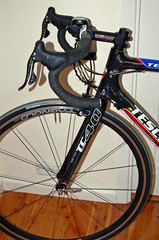

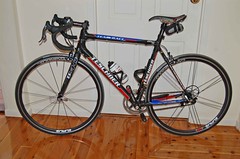
Well equipped Teschner_0744
Lincoln dropped by with one of his (many) new bikes. It's a Teschner. It's light.
Wednesday, January 14, 2009
LA pic from Adelaide via Twitter
Just sharing a pic from Lance in Adelaide (for the TDU):

Nice to see a fit Pat Jonker (past winner, retired from pro riding but still looking good). O'Grady looks like he has been working out - preparing for the Euro-season cobbles?
Nice to see a fit Pat Jonker (past winner, retired from pro riding but still looking good). O'Grady looks like he has been working out - preparing for the Euro-season cobbles?
Tuesday, January 13, 2009
Track racing of a kind we don't usually see...
40-42 G's? I don't think so... but it's obviously narrow and maybe even poorly cambered in parts... in short, scary!
Friday, December 19, 2008
Wear and tear - Elite travel
Not a bad indoor trainer, this is my 2nd (or is it 3rd?) Elite. The roller always wears like that - amazing what hot rubber will do if you try hard enough. This is probably 8 years old, but it has shared the load with an even older - 13 years or so - Elite. The tyres of course wear even faster.
It's a magnetic resisitance unit. Not the best feel but useful, especially when you run an iBike or similar power meter.

It's a magnetic resisitance unit. Not the best feel but useful, especially when you run an iBike or similar power meter.
Tuesday, November 25, 2008
Cavo bitter about 9th place
From the "oh please" category... "The biggest regret of my career is quitting the Tour. I was fighting for the green jersey. I could have potentially won on the Champs-Élysées. I made a commitment to the track team and they didn't give anything back."
Who made the choice to stop? Who chose the Olympics over a green jersey? Who actually cares?
Who made the choice to stop? Who chose the Olympics over a green jersey? Who actually cares?
Wednesday, November 12, 2008
Fat and slow. First race in 8 mths
Yes, well... I had gradually become fat and slow in the intervening 8 months. I hadn't been doing many miles, probably only 50-100km per week for the last year, so missing the entire "road season" in Australia was both a good thing - I'd have been left for dead on Blood Hill - and a bad thing - there was another 50kms of conditioning that I had left off my training diary.
So I hit this first criterium with little condition at all, bar some flat road ambling and some intervals on the indoor trainer. Ouch. My heart wasn't into it - or up to it - and I let the bunch go after 3 laps. You can see that I was consistent between numbered power peaks 1 to 5, and then it dropped off before i got going again whenever someone caught me, or I them. Power peak 8 shows me that (a) the ibike is exaggerating again - no way that was over 1600W - and (b) I had plenty in reserve. So I'm confident that by staying 'up front' throughout the race I can stay with them. Mind you, they were averaging over 34kmh, which is a bit of a stretch for me at the moment. I had anticipated averaging 33kmh at worst... or best, if you prefer. So I was hitting and exceeding my maximum by lap 3.
The yellow arrows are pointing out that the power peaks don't always align with maximum speed. Indeed it's on a slower part of the circuit - the uphill from the 90degree left turn that max Watts are generated. Whereas the top speed is downhill to the finish line.
The yellow lines show you where something was going wrong with the barometric readings - as these are laps of a circuit the altitude was fixed and should repeat, over and over. Not jump 10m or more! I'm guessing the battery was dying...
Slope is also a puzzle - 10% is possible but 20% is just not right. Battery? ibike head unit flexing? Me pulling the front wheel off the deck?
These small-medium errors add up to big - and inaccurate - power readings. You could safely halve these outrageous peaks!

So I hit this first criterium with little condition at all, bar some flat road ambling and some intervals on the indoor trainer. Ouch. My heart wasn't into it - or up to it - and I let the bunch go after 3 laps. You can see that I was consistent between numbered power peaks 1 to 5, and then it dropped off before i got going again whenever someone caught me, or I them. Power peak 8 shows me that (a) the ibike is exaggerating again - no way that was over 1600W - and (b) I had plenty in reserve. So I'm confident that by staying 'up front' throughout the race I can stay with them. Mind you, they were averaging over 34kmh, which is a bit of a stretch for me at the moment. I had anticipated averaging 33kmh at worst... or best, if you prefer. So I was hitting and exceeding my maximum by lap 3.
The yellow arrows are pointing out that the power peaks don't always align with maximum speed. Indeed it's on a slower part of the circuit - the uphill from the 90degree left turn that max Watts are generated. Whereas the top speed is downhill to the finish line.
The yellow lines show you where something was going wrong with the barometric readings - as these are laps of a circuit the altitude was fixed and should repeat, over and over. Not jump 10m or more! I'm guessing the battery was dying...
Slope is also a puzzle - 10% is possible but 20% is just not right. Battery? ibike head unit flexing? Me pulling the front wheel off the deck?
These small-medium errors add up to big - and inaccurate - power readings. You could safely halve these outrageous peaks!
Sunday, November 09, 2008
Training a 37 yo L. Armstrong
Not so different from a 34 year old one really:
With Armstrong being 37 years-old, will Carmichael be monitoring any new or different parameters this time around? "It is basically the same thing as with any athlete, the most objective marker is power," said Carmichael. "Right now, it is just trying to see if we can get power to keep going up which we anticipate to happen. We also want to see that he is getting more efficient so his kilojoules will keep going down for similar types of workouts. "Now he is starting to get more specific with his training moving out of the foundation phase and doing a little more specific work for the bike; a little more threshold work; a little more speed work. He goes to the Astana camp in December then we are planning a camp right after that where he will get behind the motor a little bit and up the volume from basically doing 24-25 hours a week up to 28-30 hours a week of training. That's a big jump on just energy expenditure so everything just has to start simplifying," said Carmichael, who once served as the US National Coaching Director.
So that's:
With Armstrong being 37 years-old, will Carmichael be monitoring any new or different parameters this time around? "It is basically the same thing as with any athlete, the most objective marker is power," said Carmichael. "Right now, it is just trying to see if we can get power to keep going up which we anticipate to happen. We also want to see that he is getting more efficient so his kilojoules will keep going down for similar types of workouts. "Now he is starting to get more specific with his training moving out of the foundation phase and doing a little more specific work for the bike; a little more threshold work; a little more speed work. He goes to the Astana camp in December then we are planning a camp right after that where he will get behind the motor a little bit and up the volume from basically doing 24-25 hours a week up to 28-30 hours a week of training. That's a big jump on just energy expenditure so everything just has to start simplifying," said Carmichael, who once served as the US National Coaching Director.
So that's:
- Measure power (ie engine output)
- Watch it go up (and do something if it doesn't)
- Move from foundation to specifics (ie start long and slow and build workouts on top)
- Become more efficient (ie run as far and as fast but on less)
Saturday, November 08, 2008
Armstrong wants more power, less speed?
That's what I think I read: Armstrong is not necessarily looking for the position that will make the bike the fastest. "It has to be a perfect mix between position and power. If I am five percent slower due to the position, but have 25 percent more power, than that will be better."
Now he may be misquoted. He may be confused, or quoted out of context. Or he's being silly. Perhaps he meant that the 'fastest' position wasn't necessarily the most comfortable and sustainable, which is fine. Perhaps he meant that the most aerodynamic position wasn't necessarily the best overall, for whatever reason. But why the heck say that he'd compromise speed for 'more power'? Wouldn't less power and more speed be even better than the reverse? What use is the extra power if it doesn't increase his speed?
Please explain!
Now he may be misquoted. He may be confused, or quoted out of context. Or he's being silly. Perhaps he meant that the 'fastest' position wasn't necessarily the most comfortable and sustainable, which is fine. Perhaps he meant that the most aerodynamic position wasn't necessarily the best overall, for whatever reason. But why the heck say that he'd compromise speed for 'more power'? Wouldn't less power and more speed be even better than the reverse? What use is the extra power if it doesn't increase his speed?
Please explain!
Subscribe to:
Posts (Atom)