Showing posts with label F75. Show all posts
Showing posts with label F75. Show all posts
Saturday, April 28, 2012
A different sort of on-bike video (Felt F75 in motion)
This is what happens when I manage to shoot some simple video on the bike and then edit it to death in AVS Video Editor. It's a Felt F75, it's me, I'm fat and slow and way past my prime but there you go. All visuals and audio by me, sound produced and mixed in Mixcraft.


Tuesday, July 13, 2010
Full-carbon, aluminium + carbon fork and aluminium + carbon fork and rear end. And steel. I've tried 'em all. And the difference is?
I'm tempted to say 'not worth arguing over', but my last steel bike was a beauty: custom higher bottom bracket height for crits, Campag all over it, fast wheels. Bought it in 1989, resprayed it in 1995 (to fend off the rust). Replaced the groupset with Mavic gear off my 1990 Look KG76 Carbon Kevlar (which took on 105 instead). Retired it for good in 1999 (rust again). Frankly, steel is a pain to maintain.
I sweat a lot, and I don't mind riding in the rain. I always clean, lube and rust-protect my steel bikes (including my Saronni-Colnago track bike, which almost never sees rain and has survived with scars and 2 re-sprays) but inevitably they rust. And I don't see (or feel) any advantage over other materials. So steel is just off the shopping list, at least for me. However my kids have cheap and cheerful steel bikes, and training wheels!
I should however say that my '85 Colnago Mexico was a great steel road bike. Smooth, effortless and hardly rusted at all. It was a great road bike but not handy at all in crits, so I got rid of it before I scratched it. As far as I know it's still intact (a friend bought it off me) and perhaps it proves that the initial treatment and care in manufacture of a steel frame makes the difference. But I can't be bothered with further experimentation given that I've already had, umm, 2 steel track bikes and 6 steel road bikes. And seriously - be they a custom frame, a Colnago or a Gitane, or even an Apollo or a Shogun - they weren't any more comfy or faster for being made of a rusty metal.
Which brings me to carbon. My Look KG76 (skinny carbon/kevlar tubes bonded to aluminium lugs) distinguished itself almost immediately by being the first bike in my experience to make 200km feel like a doddle. Seriously, it was a revelation and even put my comfy steel-framed Colnago into perspective. Whilst I can't say it was the carbon alone that made the difference, I can say that over 20 years later it's still rideable. In fact I'd race it without hesitation. What I would say is that the laid-back French frame angles matched with light but less-than-stiff wheels was the real differentiator in the comfort stakes.
One thing I have learnt from my 35 odd years of bike riding is that things break. My brother broke the steel forks on our old steel road bike. But the frame was getting close to 50 years old by that stage and the forks may have been original! Anyway, they broke catastrophically and without warning, much like my lightweight aluminium seatpost did years later...
Which brings me to aluminium frames. I have just 2 of those, both by Felt. They are ridden almost every day in all kinds of weather and raced on fine summer days. The F50, an aluminium frame with carbon fork is 6 years old (and counting) and has just broken its first spoke. The F75 is just 4 months old and has a carbon rear-end to go with a carbon fork. It's a size smaller than the F50 which fits me better but is noticeably more lively. Given the extra carbon some readers may think it would be more comfy but it's not, it's stiffer and harsher - as well as faster. I put that down to the smaller sized frame and the newer, slightly stiffer wheels rather than frame materials.
Now it gets complicated. I use 3 road bikes regularly but each is a different size with different angles, and a different mix of frame materials and wheelsets. I have Mavic vs Velocity clinchers and a variety of tyres, too. So how could I definitively "prove" what I feel? I can swap wheelsets around a bit and standardise on tyres, I guess. And I can run some tests using my power meter. But frankly, whilst I will almost certainly run some comparisons just for the heck of it, I don't think it matters too much. I can simply summarise my feelings and you can pick and choose what you want to believe. I'll even link to some further opinion afterwards ;-)
In summary I believe that :
Some other people think differently, at least in part....
Is Carbon Fiber really worth the cost of a new bike? | Ask MetaFilter

I sweat a lot, and I don't mind riding in the rain. I always clean, lube and rust-protect my steel bikes (including my Saronni-Colnago track bike, which almost never sees rain and has survived with scars and 2 re-sprays) but inevitably they rust. And I don't see (or feel) any advantage over other materials. So steel is just off the shopping list, at least for me. However my kids have cheap and cheerful steel bikes, and training wheels!
I should however say that my '85 Colnago Mexico was a great steel road bike. Smooth, effortless and hardly rusted at all. It was a great road bike but not handy at all in crits, so I got rid of it before I scratched it. As far as I know it's still intact (a friend bought it off me) and perhaps it proves that the initial treatment and care in manufacture of a steel frame makes the difference. But I can't be bothered with further experimentation given that I've already had, umm, 2 steel track bikes and 6 steel road bikes. And seriously - be they a custom frame, a Colnago or a Gitane, or even an Apollo or a Shogun - they weren't any more comfy or faster for being made of a rusty metal.
Which brings me to carbon. My Look KG76 (skinny carbon/kevlar tubes bonded to aluminium lugs) distinguished itself almost immediately by being the first bike in my experience to make 200km feel like a doddle. Seriously, it was a revelation and even put my comfy steel-framed Colnago into perspective. Whilst I can't say it was the carbon alone that made the difference, I can say that over 20 years later it's still rideable. In fact I'd race it without hesitation. What I would say is that the laid-back French frame angles matched with light but less-than-stiff wheels was the real differentiator in the comfort stakes.
One thing I have learnt from my 35 odd years of bike riding is that things break. My brother broke the steel forks on our old steel road bike. But the frame was getting close to 50 years old by that stage and the forks may have been original! Anyway, they broke catastrophically and without warning, much like my lightweight aluminium seatpost did years later...
Which brings me to aluminium frames. I have just 2 of those, both by Felt. They are ridden almost every day in all kinds of weather and raced on fine summer days. The F50, an aluminium frame with carbon fork is 6 years old (and counting) and has just broken its first spoke. The F75 is just 4 months old and has a carbon rear-end to go with a carbon fork. It's a size smaller than the F50 which fits me better but is noticeably more lively. Given the extra carbon some readers may think it would be more comfy but it's not, it's stiffer and harsher - as well as faster. I put that down to the smaller sized frame and the newer, slightly stiffer wheels rather than frame materials.
Now it gets complicated. I use 3 road bikes regularly but each is a different size with different angles, and a different mix of frame materials and wheelsets. I have Mavic vs Velocity clinchers and a variety of tyres, too. So how could I definitively "prove" what I feel? I can swap wheelsets around a bit and standardise on tyres, I guess. And I can run some tests using my power meter. But frankly, whilst I will almost certainly run some comparisons just for the heck of it, I don't think it matters too much. I can simply summarise my feelings and you can pick and choose what you want to believe. I'll even link to some further opinion afterwards ;-)
In summary I believe that :
- Frame materials do NOT inherently "feel" different. If the angles are the same and the material stiffness is the same then they will "feel" the same - to me at least. Which debunks the 'steel or carbon fibre is more comfy' theory
- However my Look KG76 Carbon Kevlar is the most comfortable road bike I've ever owned - but I put that extra comfort down to the wheelset and frame angles rather than the carbon
- Wheels really matter - stiffer wheels degrade comfort but add speed; lighter wheels add speed (or acceleration) but may be softer, especially when cornering (depends on stiffness, again)
- Carbon frames (at least those made by Look) can be stiff or soft by design and can last 20 years or more, even when raced and trained on, without any noticeable change in "feel", either
- Aluminium fails suddenly and catastrophically and like all frames should be keenly examined for damage, but after 6 years of training and racing my aluminium Felt F50 remains failure-free (touch wood!) and just as nice to ride as on day one
- Steel rusts. It can be stiff or soft by design. It also doesn't "age" and become somehow less "springy". At least not in my experience!
Some other people think differently, at least in part....
Is Carbon Fiber really worth the cost of a new bike? | Ask MetaFilter
I have been convinced that carbon fiber ages significantly every time it flexes, as does aluminum to a much lesser degree. Steel on the other hand, can flex a million times with very little measurable change in springiness. Just imagine how well a coil spring made of carbon fiber or aluminum would last.Bicycle Frame Materials - Steel, Aluminum, Titanium and Carbon Fiber, by Sheldon Brown
Did you know that:Lifespan of Carbon Fiber Frame - Topic Powered by Social Strata
* Aluminum frames have a harsh ride?
* Titanium frames are soft and whippy?
* Steel frames go soft with age, but they have a nicer ride quality?
* England's Queen Elizabeth is a kingpin of the international drug trade?
All of the above statements are equally false. There is an amazing amount of folkloric "conventional wisdom" about bicycle frames and materials that is widely disseminated, but has no basis in fact.
The reality is that you can make a good bike frame out of any of these metals, with any desired riding qualities, by selecting appropriate tubing diamters, wall thicknesses and frame geometry.
I have over 15000 miles on a 2004 Trek 5200 and I personally cannot tell any difference in the ride from the firt day to today. The frame has its share of scratches dings and such but its as supple as the day I bought it. My feeling on CF bikes is when there is a major malfunction it will just break and thats the time to replce it. I rode Steel in the 80'2 and could definitely tell age on the ride and performance after many miles. Same for an aluminum bike in the 90's. Probably not the most scientific answer you could get but its just my $.02 worth. 300 miles on a frame isnt much if you feel the bike has been cared for.STEEL, ALUMINUM, TITANIUM, CARBON, or Some Combo!
But let us not deceive ourselves. The slight weight disadvantage that comes with a steel frame makes it unusable for racing at the highest levels. A steel frame can be made that weighs in the mid to low 3-pound range. Over a non-compact aluminum frame, this is a penalty of about one pound. This is just too heavy to chase Tyler Hamilton up a category-one climb. That is why the professional peloton uses aluminum or carbon. But for the rider who does not compete at the elite level, that one-pound penalty as part of a whole rider/bike package that approaches 200 pounds (or may generously exceed it) is insignificant. And for that pound, the rider gets a bike that can take advantage of the high-tensile strength and springy elasticity of modern steel and ride a bike that is an absolute dream. No bike rides as well as a steel bike built by a skilled builder. People who disagree with this conclusion usually have either a commercial interest in other materials, or have not ridden modern steel bikes.STEEL, ALUMINUM, TITANIUM, CARBON, or Some Combo!
I believe that the feel of the road is a large part of the feedback I am looking for as I ride my bike. I am not looking to isolate myself from my cycling environment. I want to be part of it. For me, then, carbon works against my cycling goals. I have never ridden a carbon frame or fork that gives the fine, pleasant, comfortable ride under the widest set of condition that steel gives.
Monday, July 12, 2010
My Felt F75: 4 months later (updated!)
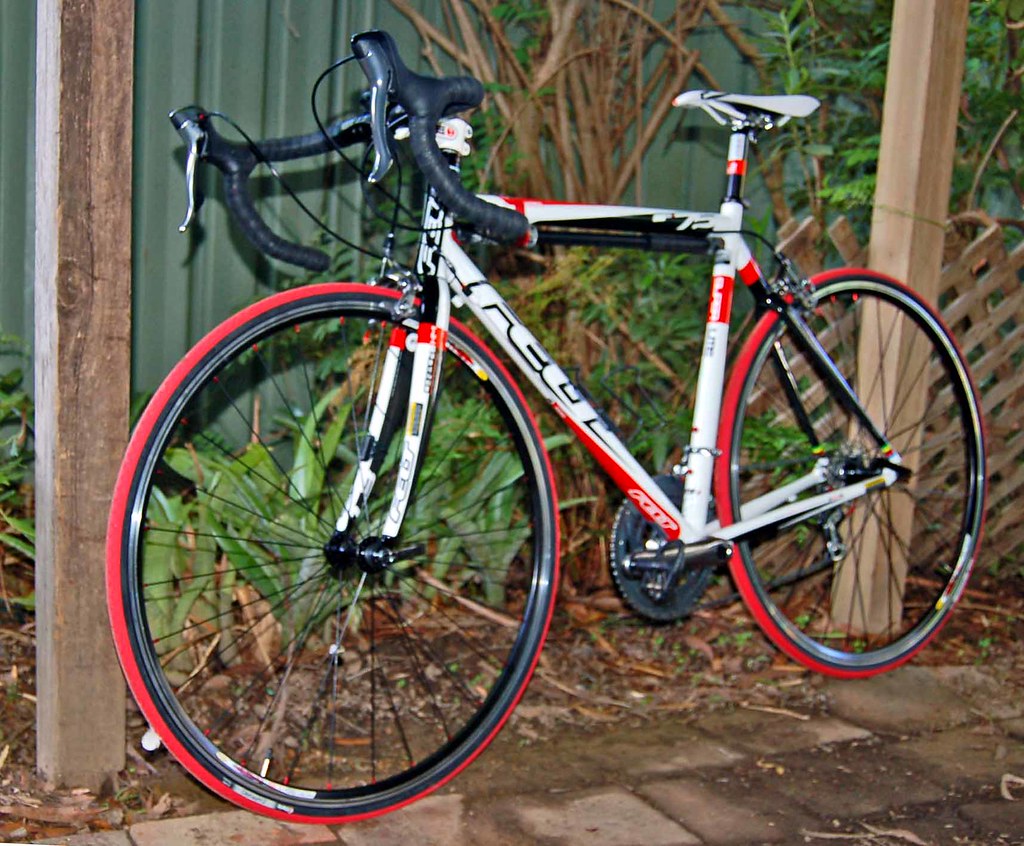
The good news first. Nice build quality and very slightly lighter than my old F50 (talking sub 8kg fully built with pedals on my scales). The red, black and white paintwork is also very cool. Just stepping on the pedals for the very first time I thought "whoa, this is quick" - but that could just be gearing, eh?
Not being one to use first impressions as a definitive guide, I made some subtle adjustments mid-ride until the saddle was just so in terms of post height and rails, and measured everything as best I could to get my position to where a true comparison would be possible. And it still felt faster, if less so. The trouble with first impressions is that mere change - just being different - can fool you into thinking it's "better". And laying out a couple of grand psychologically puts you into a defensive 'of course it's better' frame of mind anyway. Even so, first impressions weren't bad, so that's good.
The not so good news. Nothing to blame Felt for, the fit and finish is excellent for the sub-$A2,300 I paid for it. That's around $200 cheaper than the 6 year old F50 was when new and half the 1990 buy price of the all-carbon Look. However a bike is only as good as its assemblers can make it and the LBS that put it together wasn't 100% on the money. (I still like 'em though!) Trouble is I bought it from an LBS that really specialises in mountain and kids bikes. So I had to remove the plastic protective bits, the bell and the streamers. OK, I'm joking about the streamers.
I also had to adjust the headset and reroute a brake cable to make for better free movement. And tighten a few bolts that were looser than I expected.
The empirical data. So is it really faster? Well that's a harder one to answer as at age 52 with a few kids to distract me from real riding my fitness is up and down. So I have to remove the outliers in the data and "normalise" a few things. All things considered, my 'standard' rides were immediately faster - an astounding 2km/h over 30km and amost 3km/h better over 50km. I was stunned. It not only felt (ha ha) faster, it was faster. Sadly - call it 'new bike fever' - after a month the gains had almost completely disappeared. I think I just got used to it. After averaging it all out and taking into account fitness and weather variations the F75 is still up on the old F50 by 0.5kmh average overall and I'm prepared to say it has an advantage, but it's a small and diminishing one.
In terms of power I really don't expect much if any variation. I'm the same person with the same potential, and the bikes are set up pretty close to "the same". So the power I can put out should be about the same, if I have set it up right! And I haven't been able to do really fair tests as my ibike got drenched in some wet weather and has started to really eat batteries. However the few measurements I have got out of it actually do show gains in power on the flat and on "power" hills of around 20-30W average (5-10% grade). Maybe. It gets murky when comparing steeper climbs as the new bike has a compact 34/50 crankset whereas I have 39/50 on the older bike. It ain't apples to apples but I do prefer the 34 over the 39 for most hill efforts (talking 15-20% folks). Maybe the weather has been more conducive to me pumping out the Watts on the fresh new bike, or this is just normal variation in daily average wattage. I'll try to do more scientific testing as soon as I can. For now I feel faster on the new bike and it's showing in slightly higher speeds and power outputs. But I'm wondering if I should actually be getting faster speeds and lower average Wattage... hmmm.
What else can I say? Well it's standard box-section Mavic clincher rims on both bikes but the new bike has a stiffer single-cross front wheel lacing pattern. If anything the stiffer front wheel explains the 'faster' feeling, and probably translates into better overall performance - at the expense of comfort. As I really only do crits these days I'm not concerned, and the odd 50km road race isn't a problem. 150-200km road races may be different. It can be a bit jarring over rough roads.
Finally I have to say that the Dura-Ace components on my 6-year old 9-speed F50 have a better feel to them than the new 10-speed 105 groupset. Especially the gearshifting. In fact if anything I prefer the 9-speed 105 gears on the Look, circa 1998! Perhaps it all has to just wear in?
Verdict: Would I buy another one? I sure would! I'd be careful where I bought it and make sure it was set up perfectly, but it's definitely a killer bike for the money.
Subscribe to:
Posts (Atom)