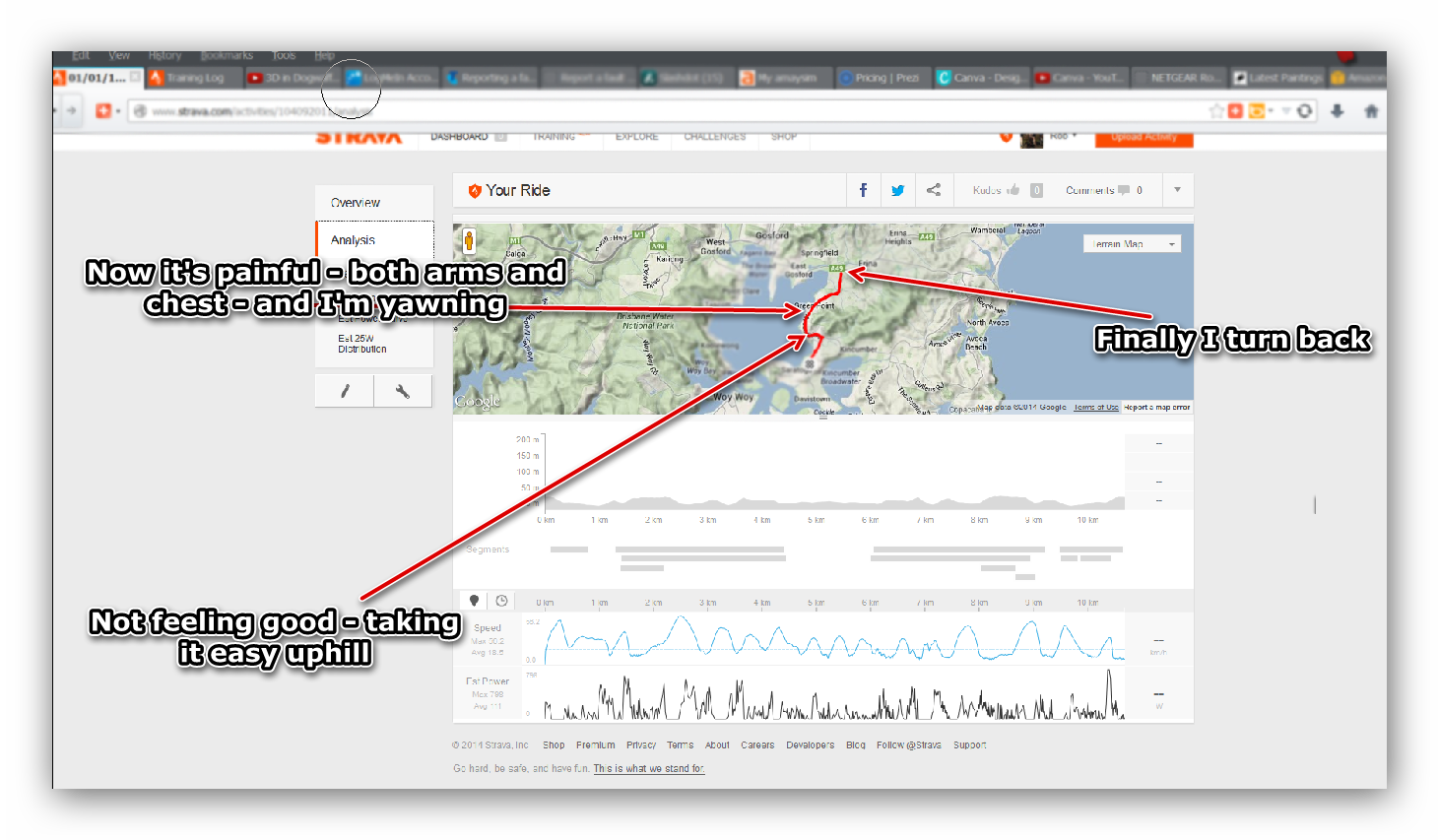
You may recall that despite having cycled some 300,000 kilometres in this tired old body of mine I still managed to have an ischaemic event (yes, a heart attack) on this very day, New Year's, 2014. As I was doing over 200km a week up to that point it came as something of a surprise to feel a persistent, dull ache that said "stop now" as I crested a familiar hill. Of course being a hardened racing cyclist I pressed on anyway, gasping and yawning, determined to "ride through it".
Until, of course, I just had to stop. I knew, deep down, what it was. Still, I didn't accept it. It seemed so unlikely. So I struck a compromise and turned around, slowly, and crawled - grovelled - home. About 15 minutes after stumbling in the door, I accepted my fate and embarked on a 6 day medical adventure involving 2 hospitals, a late night ambulance ride, 2 cardiologists and 3 stents. A month later I blogged merrily on the topic of not ignoring the bleeding obvious.
So here I am, a year later, still acting the goat. I have just tempted fate and re-lived that epic New Year's Day ride, retracing the exact route and soaking up the pain. Fortunately without the hospitalisation, touch wood. I'd like to say that I've spent the past year steadily recuperating, building up the miles and strengthening my weakened heart. But I haven't. Mind you I started well, with good intentions. I kept to a gentle, progressive plan that got me onto the indoor trainer and then out the door, building gradually. And then the confidence grew. This reconditioned heart actually seemed just as good, if not better than the old one! I set some tougher goals and pressed on. Until I started to tire.
It seemed like I was repeating the very mistake that had got me into this predicament: if in doubt, double the training. Despite the still-fresh memory, I was doing it all again. The training was going up but my form was going down. And then I caught a cold.
Now colds may slow you down but they don't have to stop you, so I backed off and came back. But the cold "freshened up". So I repeated the formula - back off, come back. And the virus came back too. It reminded me of a six-month bout of a "mystery virus" that hit me back in the late 1980s, effectively ending my club-level A-grade racing career. I didn't get a blood test then, sadly, so I'll never know for sure, but a GP reckoned it was mononucleosis. The prescription was "rest". So taking a leaf out of that same book I have had a long, long rest since the end of May.
Which is not to say I haven't ridden. Once a week I've given the bike a spin and tested my form. And mostly my form has been lousy. Given that riding every day is my long-term habit, riding just once a week - and for only 20 minutes or so - hasn't been an easy pill to swallow. And it hasn't been the ideal way to make a post-ischaemic comeback, either.
Which is why re-living my "2014 first-ever heart attack ride" today hasn't been without its measure of risk - or even fear. Sure, I took it easy. Sure, I've done the distance a few times in the lead up. Sure, it's not a century ride. But I'm not nearly as fit as I was then, and the hills are unrelenting. I live on a hill. Getting home is hard enough without worrying about blocked arteries and damaged heart muscle as well.
Anyway, I made it. It could have gone horribly wrong but it didn't. The monkey is off my back (I have avoided riding that route for a full 12 months). Hopefully I will listen to my own advice from here on and build the miles up again - very, very gradually. Fingers crossed.
Showing posts with label ischemia. Show all posts
Showing posts with label ischemia. Show all posts
Thursday, January 01, 2015
Friday, March 21, 2014
Update on recovery from ischaemia
Well as you may already know I had a heart attack on January 1 this year. To be perfectly honest, upon reflection, it was fairly minor as far as ischaemic events go - but ignoring it wasn't an option. Well 60-odd years ago ignoring it was probably the only option. I remember one of my grandfathers (who 'survived' in some senses service in 2 world wars) took 'angina tablets' when the pain came on. He probably had a blocked artery or 2 but there was little you could realistically - or affordably - do about it back then. Whereas in my case they simply inserted a few stents and inflated them, unblocking the blocked artery. It took 45 minutes (if you discount failed attempt number 1, an ambulance trip and brief stays in 2 hospitals). Fixed!
Well, mostly fixed. I'm not exactly the same as I was, psychologically or physically. I am unblocked, with a renewed blood supply to the organ in question, but said heart now has muscle tissue damage, some of it irreparable, if to a minor degree. Nevertheless my heart beats strongly and regularly, and after almost 3 months of training on the bike (half on the trainer and half on the road) I am back to where I was in December last year - doing at least 200km a week on the road. Mostly flat and only 60% intensity, though. And just a few intervals at 80% or so. And no long, hard climbs for now.
Yet there remains a small, disquieting fear that the heart will be weakened, unable to cope with "normal" training (let alone racing) loads. And statistically that is borne out by those who have repeat heart attacks after their first. So I'm tentative, still. A new clot could form over the stents themselves, for example. But with each passing mile I get more confident that I'm OK. Indeed I feel "better" in many ways. Whereas I was grinding it out for the previous few months (before the attack) I am now refreshed and eager. My body is responding positively if slowly to the training load, whereas it was only slowing down and going backwards before.
Another realisation is that heart attacks can be - indeed often are - "silent". You may not notice you are having one. The one I had, whilst distinctive, was dull and incapacitating for a couple of hours, like dragging a heavy weight around, rather than endlessly sharp and totally, unavoidably crippling, if you can see the distinction. Indeed I began to feel "better" after about 3 hours of this crushing bore of a monumental chest and arm pain. I could see a way out. But by then I was in hospital, which is the best place to be if you want to get "fixed".
Still, I could see how ignoring it and just avoiding strenuous exercise forevermore may - in some cases - work out. But for me I wanted to ride again, and I didn't want to risk the statistically significant attack number 2, the one that would sneak up on me and do me in for good. And it made me ask, 'ok, this is different, it's really bad - but have I had one of these before, just milder?'. And my answer would be "yes". This was just a new level of pain and injury.
Hindsight is a wonderful thing but the last 3 months of training pre-attack, sometimes in terrible heat, often had me thinking 'what's wrong?'. And whilst I could do it, I could finish the rides - and the occasional races - I didn't push to my old limits. I backed off. I let the bunch go on the last lap. I gave in to the "pain" of the effort. Whilst it wasn't that distinctive full-on crushing pain, I now recognise that what I thought was "not enough training" or "just old age" was probably a very mild form of heart attack. I have no firm evidence, no blood tests or angiograms to back that up, but it's what I suspect. Whilst my heart attack represents a certain event, the rupturing of some plaque and for a time the complete blockage of a coronary artery, in truth that artery was significantly narrowed for years.
My heart was under attack from reduced blood flow for a long time. I just didn't read the signs.
Well, mostly fixed. I'm not exactly the same as I was, psychologically or physically. I am unblocked, with a renewed blood supply to the organ in question, but said heart now has muscle tissue damage, some of it irreparable, if to a minor degree. Nevertheless my heart beats strongly and regularly, and after almost 3 months of training on the bike (half on the trainer and half on the road) I am back to where I was in December last year - doing at least 200km a week on the road. Mostly flat and only 60% intensity, though. And just a few intervals at 80% or so. And no long, hard climbs for now.
Yet there remains a small, disquieting fear that the heart will be weakened, unable to cope with "normal" training (let alone racing) loads. And statistically that is borne out by those who have repeat heart attacks after their first. So I'm tentative, still. A new clot could form over the stents themselves, for example. But with each passing mile I get more confident that I'm OK. Indeed I feel "better" in many ways. Whereas I was grinding it out for the previous few months (before the attack) I am now refreshed and eager. My body is responding positively if slowly to the training load, whereas it was only slowing down and going backwards before.
Another realisation is that heart attacks can be - indeed often are - "silent". You may not notice you are having one. The one I had, whilst distinctive, was dull and incapacitating for a couple of hours, like dragging a heavy weight around, rather than endlessly sharp and totally, unavoidably crippling, if you can see the distinction. Indeed I began to feel "better" after about 3 hours of this crushing bore of a monumental chest and arm pain. I could see a way out. But by then I was in hospital, which is the best place to be if you want to get "fixed".
Still, I could see how ignoring it and just avoiding strenuous exercise forevermore may - in some cases - work out. But for me I wanted to ride again, and I didn't want to risk the statistically significant attack number 2, the one that would sneak up on me and do me in for good. And it made me ask, 'ok, this is different, it's really bad - but have I had one of these before, just milder?'. And my answer would be "yes". This was just a new level of pain and injury.
Hindsight is a wonderful thing but the last 3 months of training pre-attack, sometimes in terrible heat, often had me thinking 'what's wrong?'. And whilst I could do it, I could finish the rides - and the occasional races - I didn't push to my old limits. I backed off. I let the bunch go on the last lap. I gave in to the "pain" of the effort. Whilst it wasn't that distinctive full-on crushing pain, I now recognise that what I thought was "not enough training" or "just old age" was probably a very mild form of heart attack. I have no firm evidence, no blood tests or angiograms to back that up, but it's what I suspect. Whilst my heart attack represents a certain event, the rupturing of some plaque and for a time the complete blockage of a coronary artery, in truth that artery was significantly narrowed for years.
My heart was under attack from reduced blood flow for a long time. I just didn't read the signs.


Tuesday, February 11, 2014
Heart problems bring Kaisen's career to a premature end : SBS Cycling Central
Timely indeed, given my own situation. This is Lotto Belisol's Olivier Kaisen on his heart problem:
"At training camp in December I was able to train in perfect circumstances without any problem. Now I think my moderate season in 2013 might be caused by it." Kaisen first noticed the problem during the Tour Down Under in January."After the second stage at the Tour Down Under I didn't feel well. It had been a very tiring and extremely hot day and I had ridden much at the head of the bunch for André Greipel. I did start the next stage, but immediately after the start of the third stage I felt something was wrong. I was scared and together with sports director Herman Frison I decided to quit. He said I couldn't take any risk.
The thing is, and I know this from hindsight more than any analytical brilliance, as you tend to grow into your body over time, it so rarely surprises you. You simply get used to its quirks. After all, you don't get to experience what other hearts are like, although you may still realise that there's a huge diversity in what are "normal" rhythms and rates of beating. Some are fast, some are slow and some are all over the shop. Yet they "do the job". Mostly. So you get "used" to your own quirks and they fade into the background... until one day...
And if you race - or even train hard - you are putting a hefty load on that single point of failure. That load can be extreme in a race, especially if you are dehydrated or have some other variation from the "norm" that one day may create that "perfect storm" that is ischaemia. Now hindsight is a wonderful thing and I don't want to put anyone off cycling to their full potential - far from it - but we can't see into our bodies as we go about our daily lives (well, not without some help, anyway). We have to go by feel. And that's why we need to look after ourselves, eat, rest and train right, and keep a look-out for anything that feels 'unusual'. It could be a sign that shouldn't be ignored.
"At training camp in December I was able to train in perfect circumstances without any problem. Now I think my moderate season in 2013 might be caused by it." Kaisen first noticed the problem during the Tour Down Under in January."After the second stage at the Tour Down Under I didn't feel well. It had been a very tiring and extremely hot day and I had ridden much at the head of the bunch for André Greipel. I did start the next stage, but immediately after the start of the third stage I felt something was wrong. I was scared and together with sports director Herman Frison I decided to quit. He said I couldn't take any risk.
The thing is, and I know this from hindsight more than any analytical brilliance, as you tend to grow into your body over time, it so rarely surprises you. You simply get used to its quirks. After all, you don't get to experience what other hearts are like, although you may still realise that there's a huge diversity in what are "normal" rhythms and rates of beating. Some are fast, some are slow and some are all over the shop. Yet they "do the job". Mostly. So you get "used" to your own quirks and they fade into the background... until one day...
And if you race - or even train hard - you are putting a hefty load on that single point of failure. That load can be extreme in a race, especially if you are dehydrated or have some other variation from the "norm" that one day may create that "perfect storm" that is ischaemia. Now hindsight is a wonderful thing and I don't want to put anyone off cycling to their full potential - far from it - but we can't see into our bodies as we go about our daily lives (well, not without some help, anyway). We have to go by feel. And that's why we need to look after ourselves, eat, rest and train right, and keep a look-out for anything that feels 'unusual'. It could be a sign that shouldn't be ignored.
OK, last post on this for a bit...
More screenshots of the "ischaemic event"... even more self-explanatory!


My original post on how it all happened. Plus some stats and other nonsense.
My original post on how it all happened. Plus some stats and other nonsense.
Did you want some pictures to go with that ischaemia, sir?
Did you read this: http://addicted2wheels.blogspot.com.au/2014/02/double-training-used-to-work-dont-let.html? Want to know more? Sure, how about some pics? No, not of the stents being inserted (although... now that I think about it, maybe tomorrow?) just some Strava screenshots of me having a "medical event" during a training ride....
It's fairly self-explanatory... 2013 wasn't a bad year for cycling but not great either. I peaked a couple of times with semi-decent months but got sick a few times that wrecked my race season (which turned out to be a good thing, maybe). I was playing catch-up all year. And then 2013 ended and 2014 went off with a bang (or a whimper perhaps)...
 Just another year? And then...
 One ride too many!
 I didn't feel well at all...
 And the figures prove it!
 'Creeping' is the word
 As I said, I ride a bit
 And I'm still riding!
 Hopefully I'll keep it up...
My original post on how it all happened. Some stats and other nonsense. And more.
It's fairly self-explanatory... 2013 wasn't a bad year for cycling but not great either. I peaked a couple of times with semi-decent months but got sick a few times that wrecked my race season (which turned out to be a good thing, maybe). I was playing catch-up all year. And then 2013 ended and 2014 went off with a bang (or a whimper perhaps)...
My original post on how it all happened. Some stats and other nonsense. And more.
Monday, February 10, 2014
Double the training used to work. Now I'm not so sure. Or don't let age slow you down!
OK, so it 'used' to work. When I was 25 or so, anyway. Even when I was 35. But it started to go awry when I turned 42 or so. I'd always been relatively sensible in terms of avoiding over-training, making sure I ate right, or close anyway, and getting a bit of sleep. But the rules of thumb seemed to be breaking down. One moment all was well and consecutive 100km races on a weekend were fine, the next... not so good.
My rules of thumb? Number one, given a healthy diet and enough rest, is to train three times the distance of any given race per week, averaged over at least one month, preferably 3. After 3, back off, recover and build up again (preferably to a higher level). So if you want to race 100km, train at least 300km per week, average. That gives you base miles, basically. Build on that with specificity. I do have other rules of thumb but that's the main one.
Anyway, it worked for me until I was about 42 or so, but the signs of a problem were there from about 35, if I'd cared to look. I'd injure more easily. I couldn't mix-and-match sports as well as I used to (I was becoming highly cycling-specific but not entirely by choice!). And I was getting sick (mostly colds, mouth ulcers etc; irritants rather than 'show-stoppers') too often. And then it all went pear-shaped from my late 40s onwards. Now some of us will be luckier than others - some even less lucky than me - but my body reacted to aging by randomly mutating, as it were. It may have been stress-related, or environmental exposure to something I didn't even see. And it sent me on a medical-merry-go-round that hasn't ended.
But I persisted with training and racing, even if my racing suffered somewhat and became less frequent (I also had a young family, so was time-poor.) And that continued activity may have helped me fend off stage 2 of my medical maladies. Good aerobic fitness may well have protected me from the worst of my genetic (and perhaps dietary) failings. Which is to say that my heart attack at age 56 (whilst training, of course) was less severe than it may have been. And after 6 days off the bike I was back on - the trainer, anyway. A month or so later I am back on the road, feeling good - if a bit tentative.
What struck me down was high blood pressure, genetics and perhaps a love of dairy products. One coronary artery was significantly clogged and (since this was a new experience to me) I didn't recognise all of the early signs. Sure, I was 'treating' the high blood pressure with training (it works, up to a point, too). And I was still strong - still setting and re-setting Strava KOMs for example - but I became exhausted far too easily. There was no 'pain' as such, just lethargy and a feeling that I should 'go easy' today. Almost every day. At the time I put it down to all of the other medical issues I have collected (as you do) as well as "getting older". But when these new, sudden pains came I recognised immediately that although I had never experienced exactly this crushing sensation before, or the pain in both arms, I knew what the problem was: the heart. And I realised also that I had come 'close' to a similar feeling at the sharp end of a long sprint after a hard crit, several times. But unlike previous occasions I remained breathless and in pain, and it didn't go away. Not when I slowed down, nor even when I stopped.
Being both stupid and a cyclist (the 2 go hand-in-hand) I rode home with the pain, if rather slowly. I ran through some alternative options and even saw an ambulance and thought about flagging it down. I also remembered I had a mobile phone, my wife could pick me up in the car. Then again, I thought, maybe this is just an adverse reaction to the usual prescription medication I took this morning and it'll get better. Maybe I can just ride through this?
Oh yeah, and I live on a hill. My GPS data tells me it was the slowest I had ever ridden that hill, too. But I still wasn't the slowest. (Yes, I checked in Strava to be sure.) Although I knew with 90% certainty it was a heart attack I still wondered how I could ride home, uphill, whilst having an attack. Is that possible? And since I was averaging 200km/week I wondered how it was even possible that this could be happening at all. But it was.
The best part of 5 days in hospital and 3 stents have 'fixed' the clogged artery, now I just have to rebuild and get confident again. It takes time. So today's lesson? Don't think it can't happen. Cyclists - even long-time obsessively daily trainers like me - can have heart attacks. So be alert and react quickly and appropriately (like, stop riding and get medical help). Don't hesitate.
And yes, that daily training probably minimised the damage as well as fended off the day of the eventual heart attack itself. But listen to your body; if you aren't getting the training effect you used to get - and you are even going backwards - don't double the miles, instead take a rest or even have a chat with a doctor. It may just be over-training, lack of rest - or even an early warning sign of something far, far worse!
Some stats and other nonsense. And more.
My rules of thumb? Number one, given a healthy diet and enough rest, is to train three times the distance of any given race per week, averaged over at least one month, preferably 3. After 3, back off, recover and build up again (preferably to a higher level). So if you want to race 100km, train at least 300km per week, average. That gives you base miles, basically. Build on that with specificity. I do have other rules of thumb but that's the main one.
Anyway, it worked for me until I was about 42 or so, but the signs of a problem were there from about 35, if I'd cared to look. I'd injure more easily. I couldn't mix-and-match sports as well as I used to (I was becoming highly cycling-specific but not entirely by choice!). And I was getting sick (mostly colds, mouth ulcers etc; irritants rather than 'show-stoppers') too often. And then it all went pear-shaped from my late 40s onwards. Now some of us will be luckier than others - some even less lucky than me - but my body reacted to aging by randomly mutating, as it were. It may have been stress-related, or environmental exposure to something I didn't even see. And it sent me on a medical-merry-go-round that hasn't ended.
But I persisted with training and racing, even if my racing suffered somewhat and became less frequent (I also had a young family, so was time-poor.) And that continued activity may have helped me fend off stage 2 of my medical maladies. Good aerobic fitness may well have protected me from the worst of my genetic (and perhaps dietary) failings. Which is to say that my heart attack at age 56 (whilst training, of course) was less severe than it may have been. And after 6 days off the bike I was back on - the trainer, anyway. A month or so later I am back on the road, feeling good - if a bit tentative.
What struck me down was high blood pressure, genetics and perhaps a love of dairy products. One coronary artery was significantly clogged and (since this was a new experience to me) I didn't recognise all of the early signs. Sure, I was 'treating' the high blood pressure with training (it works, up to a point, too). And I was still strong - still setting and re-setting Strava KOMs for example - but I became exhausted far too easily. There was no 'pain' as such, just lethargy and a feeling that I should 'go easy' today. Almost every day. At the time I put it down to all of the other medical issues I have collected (as you do) as well as "getting older". But when these new, sudden pains came I recognised immediately that although I had never experienced exactly this crushing sensation before, or the pain in both arms, I knew what the problem was: the heart. And I realised also that I had come 'close' to a similar feeling at the sharp end of a long sprint after a hard crit, several times. But unlike previous occasions I remained breathless and in pain, and it didn't go away. Not when I slowed down, nor even when I stopped.
Being both stupid and a cyclist (the 2 go hand-in-hand) I rode home with the pain, if rather slowly. I ran through some alternative options and even saw an ambulance and thought about flagging it down. I also remembered I had a mobile phone, my wife could pick me up in the car. Then again, I thought, maybe this is just an adverse reaction to the usual prescription medication I took this morning and it'll get better. Maybe I can just ride through this?
Oh yeah, and I live on a hill. My GPS data tells me it was the slowest I had ever ridden that hill, too. But I still wasn't the slowest. (Yes, I checked in Strava to be sure.) Although I knew with 90% certainty it was a heart attack I still wondered how I could ride home, uphill, whilst having an attack. Is that possible? And since I was averaging 200km/week I wondered how it was even possible that this could be happening at all. But it was.
The best part of 5 days in hospital and 3 stents have 'fixed' the clogged artery, now I just have to rebuild and get confident again. It takes time. So today's lesson? Don't think it can't happen. Cyclists - even long-time obsessively daily trainers like me - can have heart attacks. So be alert and react quickly and appropriately (like, stop riding and get medical help). Don't hesitate.
And yes, that daily training probably minimised the damage as well as fended off the day of the eventual heart attack itself. But listen to your body; if you aren't getting the training effect you used to get - and you are even going backwards - don't double the miles, instead take a rest or even have a chat with a doctor. It may just be over-training, lack of rest - or even an early warning sign of something far, far worse!
Some stats and other nonsense. And more.
Subscribe to:
Posts (Atom)