Triggered by a crash and associated trauma? Brought on by subsequent medication? Or just going to happen one day anyway? We are only guessing.
The BMC Racing Team today announced that it has removed its Belgian rider Klaas Lodewyck from competition after he experienced irregular heart rhythms during racing and training.
"He had been experiencing some irregular heart rhythm during racing and training," team doctor Max Testa said. "We have been investigating it, first by having him evaluated by sports cardiologists in Belgium. The common decision between a specialist there and the BMC Racing Team's
medical staff is to rest Klaas for an undetermined amount of time while a thorough investigation is performed." BMC's Lodewyck sidelined with cardiac arrhythmia | Cyclingnews.com
Point is, it can happen anytime, to anyone. Cyclingnews lists a few more...
Lodewyck is not the only rider to suffer from cardiac arrhythmia - former cyclo-cross world champion Niels Albert was forced to retire prematurely because of heart problems, and Belkin's Robert Gesink stopped racing in June to have an arrhythmia treated. Other riders who have had cardiac issues in recent years include Nick Nuyens, Haimar Zubeldia, Nicolas Vogondy, Nicolas Portal and Kim Kirchen.
Not surprisingly they didn't mention me. Whilst I can't speak for any of the above-named, I can of course speak for myself. I have ridden over 300,000km in racing and training, a very small amount of it at state "open" level but mostly at all levels of club racing. I never imagined that my heart would ever give me trouble. Even when I started to get the odd 'feeling' I dismissed it. And whilst I pushed myself pretty hard - as hard as my limited training time allowed - I rarely felt as though I had pushed "too" hard. Maybe sometimes, but isn't that what you are supposed to do? I always trained 'properly' before racing. I did my base miles. I even ate well, mostly, and hardly ever drank alcohol.
I guess I managed pretty well what I could control. Or so I thought. (Hypertension and stress might be things that I could have controlled a bit better, though.) The other factors - those out of my control - included my genetic predisposition. And in hindsight that's a pretty big one. Cardiac issues on both sides of my family should have given me a hint.
Coupled with starting a family a bit later than most and juggling racing, training, work and that growing family, I was probably cutting things a little fine. And when I then started at university intending to pick up a mature-age degree or two, I noticed that my health was going a little awry... aren't warning signs wonderful?
Only if you read them right! Naturally I thought, "it's stress" and decided to make things better by cranking up the pace - let's get this degree thing over and done with sooner rather than later. Probably not the right choice, but it was the choice I made. And thus an "unexpected" illness arrived in my life, coupled with medication that did nothing positive for my existing, if somewhat hidden, cardiac risk factors.
Of course I didn't ask for a heart attack. Indeed I thought that riding and racing would protect me from such a thing. But I was wrong. It doesn't have to be an outright ischaemia, it can be a mild arrhythmia. But with only one heart allocation per person it's better to listen carefully to your body and assess all of the factors involved. Life is a balance of positives and negatives. Striking the right balance is vital.
Thursday, August 07, 2014
Friday, July 11, 2014
Yet another sealed drivetrain
Planetary gears, this time. Sealed into the bottom bracket of course. And no, not for the first time! Still, it's a good idea, especially when you run in mud, dust and grit. The downsides will as always be weight, weight and weight, followed by serviceability, longevity and, yes, weight again. You can throw in friction losses as well, but that may be quite minor compared with, umm, weight. We shall of course see!
Nuseti mountain bike features a sealed drivetrain
Nuseti mountain bike features a sealed drivetrain


Thursday, July 10, 2014
Life goes on, even for Froome.
I watched Froome drop for maybe the 4th time in this year's TdF and thought to myself, "he'll stop now". He has an amazing acceleration on steep climbs, perhaps better than anyone else, yet he always looks ungainly, as if he is about to lurch sideways off his bike. He also has bike skills I can only dream of, although clearly he could improve on those a bit, too. He was also in pain, clearly. And he was about to reach the first cobbles.
Nibali appears better than most at predicting "what happens next" and avoiding the worst of it. For some reason when riding and racing I could 'usually' sense when it was about to go pear-shaped, too. Sometimes that worked well, in that I missed going over the top, other times it was a false alarm and I had to work harder to regain lost ground. Sometimes I just hit the deck anyway. But stopping in a club crit is very different from stopping in Le Tour. But Froome stopped anyway.
In my case I have fallen, recovered and ridden again. I have trained, lost or won, and ridden again. I've managed to block an artery and be hospitalised, yet here I am riding again. I think it's just life. You go on. Froome will pick himself up and ride again. Some riders are luckier than others, of course. Froome has had a bit of bad luck and only he knows for sure how much of that luck he attracted to himself. Was he unfocused? Was he too fearful? Was he too far back or on the wrong wheel? I can't be sure, but he knows. Whatever the truth of it, he'll be back.
Nibali appears better than most at predicting "what happens next" and avoiding the worst of it. For some reason when riding and racing I could 'usually' sense when it was about to go pear-shaped, too. Sometimes that worked well, in that I missed going over the top, other times it was a false alarm and I had to work harder to regain lost ground. Sometimes I just hit the deck anyway. But stopping in a club crit is very different from stopping in Le Tour. But Froome stopped anyway.
In my case I have fallen, recovered and ridden again. I have trained, lost or won, and ridden again. I've managed to block an artery and be hospitalised, yet here I am riding again. I think it's just life. You go on. Froome will pick himself up and ride again. Some riders are luckier than others, of course. Froome has had a bit of bad luck and only he knows for sure how much of that luck he attracted to himself. Was he unfocused? Was he too fearful? Was he too far back or on the wrong wheel? I can't be sure, but he knows. Whatever the truth of it, he'll be back.
Friday, March 21, 2014
Update on recovery from ischaemia
Well as you may already know I had a heart attack on January 1 this year. To be perfectly honest, upon reflection, it was fairly minor as far as ischaemic events go - but ignoring it wasn't an option. Well 60-odd years ago ignoring it was probably the only option. I remember one of my grandfathers (who 'survived' in some senses service in 2 world wars) took 'angina tablets' when the pain came on. He probably had a blocked artery or 2 but there was little you could realistically - or affordably - do about it back then. Whereas in my case they simply inserted a few stents and inflated them, unblocking the blocked artery. It took 45 minutes (if you discount failed attempt number 1, an ambulance trip and brief stays in 2 hospitals). Fixed!
Well, mostly fixed. I'm not exactly the same as I was, psychologically or physically. I am unblocked, with a renewed blood supply to the organ in question, but said heart now has muscle tissue damage, some of it irreparable, if to a minor degree. Nevertheless my heart beats strongly and regularly, and after almost 3 months of training on the bike (half on the trainer and half on the road) I am back to where I was in December last year - doing at least 200km a week on the road. Mostly flat and only 60% intensity, though. And just a few intervals at 80% or so. And no long, hard climbs for now.
Yet there remains a small, disquieting fear that the heart will be weakened, unable to cope with "normal" training (let alone racing) loads. And statistically that is borne out by those who have repeat heart attacks after their first. So I'm tentative, still. A new clot could form over the stents themselves, for example. But with each passing mile I get more confident that I'm OK. Indeed I feel "better" in many ways. Whereas I was grinding it out for the previous few months (before the attack) I am now refreshed and eager. My body is responding positively if slowly to the training load, whereas it was only slowing down and going backwards before.
Another realisation is that heart attacks can be - indeed often are - "silent". You may not notice you are having one. The one I had, whilst distinctive, was dull and incapacitating for a couple of hours, like dragging a heavy weight around, rather than endlessly sharp and totally, unavoidably crippling, if you can see the distinction. Indeed I began to feel "better" after about 3 hours of this crushing bore of a monumental chest and arm pain. I could see a way out. But by then I was in hospital, which is the best place to be if you want to get "fixed".
Still, I could see how ignoring it and just avoiding strenuous exercise forevermore may - in some cases - work out. But for me I wanted to ride again, and I didn't want to risk the statistically significant attack number 2, the one that would sneak up on me and do me in for good. And it made me ask, 'ok, this is different, it's really bad - but have I had one of these before, just milder?'. And my answer would be "yes". This was just a new level of pain and injury.
Hindsight is a wonderful thing but the last 3 months of training pre-attack, sometimes in terrible heat, often had me thinking 'what's wrong?'. And whilst I could do it, I could finish the rides - and the occasional races - I didn't push to my old limits. I backed off. I let the bunch go on the last lap. I gave in to the "pain" of the effort. Whilst it wasn't that distinctive full-on crushing pain, I now recognise that what I thought was "not enough training" or "just old age" was probably a very mild form of heart attack. I have no firm evidence, no blood tests or angiograms to back that up, but it's what I suspect. Whilst my heart attack represents a certain event, the rupturing of some plaque and for a time the complete blockage of a coronary artery, in truth that artery was significantly narrowed for years.
My heart was under attack from reduced blood flow for a long time. I just didn't read the signs.
Well, mostly fixed. I'm not exactly the same as I was, psychologically or physically. I am unblocked, with a renewed blood supply to the organ in question, but said heart now has muscle tissue damage, some of it irreparable, if to a minor degree. Nevertheless my heart beats strongly and regularly, and after almost 3 months of training on the bike (half on the trainer and half on the road) I am back to where I was in December last year - doing at least 200km a week on the road. Mostly flat and only 60% intensity, though. And just a few intervals at 80% or so. And no long, hard climbs for now.
Yet there remains a small, disquieting fear that the heart will be weakened, unable to cope with "normal" training (let alone racing) loads. And statistically that is borne out by those who have repeat heart attacks after their first. So I'm tentative, still. A new clot could form over the stents themselves, for example. But with each passing mile I get more confident that I'm OK. Indeed I feel "better" in many ways. Whereas I was grinding it out for the previous few months (before the attack) I am now refreshed and eager. My body is responding positively if slowly to the training load, whereas it was only slowing down and going backwards before.
Another realisation is that heart attacks can be - indeed often are - "silent". You may not notice you are having one. The one I had, whilst distinctive, was dull and incapacitating for a couple of hours, like dragging a heavy weight around, rather than endlessly sharp and totally, unavoidably crippling, if you can see the distinction. Indeed I began to feel "better" after about 3 hours of this crushing bore of a monumental chest and arm pain. I could see a way out. But by then I was in hospital, which is the best place to be if you want to get "fixed".
Still, I could see how ignoring it and just avoiding strenuous exercise forevermore may - in some cases - work out. But for me I wanted to ride again, and I didn't want to risk the statistically significant attack number 2, the one that would sneak up on me and do me in for good. And it made me ask, 'ok, this is different, it's really bad - but have I had one of these before, just milder?'. And my answer would be "yes". This was just a new level of pain and injury.
Hindsight is a wonderful thing but the last 3 months of training pre-attack, sometimes in terrible heat, often had me thinking 'what's wrong?'. And whilst I could do it, I could finish the rides - and the occasional races - I didn't push to my old limits. I backed off. I let the bunch go on the last lap. I gave in to the "pain" of the effort. Whilst it wasn't that distinctive full-on crushing pain, I now recognise that what I thought was "not enough training" or "just old age" was probably a very mild form of heart attack. I have no firm evidence, no blood tests or angiograms to back that up, but it's what I suspect. Whilst my heart attack represents a certain event, the rupturing of some plaque and for a time the complete blockage of a coronary artery, in truth that artery was significantly narrowed for years.
My heart was under attack from reduced blood flow for a long time. I just didn't read the signs.
Do we need this? Darwin Bicycle folds forward for the climbs and sprints
Do we need this? Do we "need" anything (other than food, drink, shelter, love...) anyway? In some ways it makes sense, that you remain seated and stable in particular holds great promise. However it becomes rather tricky to keep an ideal, or perhaps optimal (shades of grey there) riding position when the bike keeps adapting around you. There's power output to consider, sure, as well as cadence, weight distribution and areodynamics to consider. To get all of that right on a moving, adjusting frame could prove tricky, especially for the rider who just wants to move forward a bit to stretch. Still, a bike that adapts to you sounds "right" somehow. As long as it doesn't weigh too much, of course.
Darwin Bicycle folds forward for the climbs and sprints
Darwin Bicycle folds forward for the climbs and sprints
Thursday, February 13, 2014
Confidence is everything - the psychology of cycling
Or the psychology of everything, really.
I can tell you how to train your guts out, how to identify your strengths and weaknesses and how to position yourself to win, but none of that will help at all if you don't truly believe in yourself.
I used to train 10 to 15 thousand kays a year - not enough, I know - but it got me into the ballpark (as an A-grade clubbie, anyway). I had some condition. I had some strength. I didn't fade too early. I was there.
I enjoyed the physical side of training and it got me fit enough to be in the game - but I needed some psychological help, too. I needed both the skills of a racer and the motivation to execute my plans. The skills came about by watching, by listening and by practising. By running it through my head as well as actually racing it out on the road.
Winning is first of all about surviving. Getting dropped is the pits. And if you have the condition - enough of it - then it's all about timing and positioning from there, really. Positioning and timing to avoid crashes, to avoid missing the break and to be there - in the right place, on the right wheel - for the sprint. Simple, eh? But how do you get it right?
For me, my head had to get it together. The training helped, the sprint repeats and intervals, the mindless laps all played a part. But it was my head that desired to win and it was my head that had to learn the hardest lessons.
My head had to understand that getting dropped hurts enough that I didn't want to get dropped ever again. And I had to be smart enough to recognise the signs and avoid the danger zones, those points in a race when getting dropped is a very real possibility. Sometimes it's positioning for a hill, sometimes it's just gritting the teeth, chasing and absolutely not letting them go!
My head also had to handle the fight for the break - be in it! Get in there, but only when it's the right move. Size it up, make a judgement. Then commit. Totally.
My head also had to mix it up in the fight for the pre-sprint positioning as well as the tussle for line honours. Sometimes it's frustrating, sometimes just plain dangerous. It's reactive and exciting, physical and mental. It's the end game and it's mostly played out in your mind!
I can tell you how to train your guts out, how to identify your strengths and weaknesses and how to position yourself to win, but none of that will help at all if you don't truly believe in yourself.
I used to train 10 to 15 thousand kays a year - not enough, I know - but it got me into the ballpark (as an A-grade clubbie, anyway). I had some condition. I had some strength. I didn't fade too early. I was there.
I enjoyed the physical side of training and it got me fit enough to be in the game - but I needed some psychological help, too. I needed both the skills of a racer and the motivation to execute my plans. The skills came about by watching, by listening and by practising. By running it through my head as well as actually racing it out on the road.
Winning is first of all about surviving. Getting dropped is the pits. And if you have the condition - enough of it - then it's all about timing and positioning from there, really. Positioning and timing to avoid crashes, to avoid missing the break and to be there - in the right place, on the right wheel - for the sprint. Simple, eh? But how do you get it right?
For me, my head had to get it together. The training helped, the sprint repeats and intervals, the mindless laps all played a part. But it was my head that desired to win and it was my head that had to learn the hardest lessons.
My head had to understand that getting dropped hurts enough that I didn't want to get dropped ever again. And I had to be smart enough to recognise the signs and avoid the danger zones, those points in a race when getting dropped is a very real possibility. Sometimes it's positioning for a hill, sometimes it's just gritting the teeth, chasing and absolutely not letting them go!
My head also had to handle the fight for the break - be in it! Get in there, but only when it's the right move. Size it up, make a judgement. Then commit. Totally.
My head also had to mix it up in the fight for the pre-sprint positioning as well as the tussle for line honours. Sometimes it's frustrating, sometimes just plain dangerous. It's reactive and exciting, physical and mental. It's the end game and it's mostly played out in your mind!
Tuesday, February 11, 2014
Heart problems bring Kaisen's career to a premature end : SBS Cycling Central
Timely indeed, given my own situation. This is Lotto Belisol's Olivier Kaisen on his heart problem:
"At training camp in December I was able to train in perfect circumstances without any problem. Now I think my moderate season in 2013 might be caused by it." Kaisen first noticed the problem during the Tour Down Under in January."After the second stage at the Tour Down Under I didn't feel well. It had been a very tiring and extremely hot day and I had ridden much at the head of the bunch for André Greipel. I did start the next stage, but immediately after the start of the third stage I felt something was wrong. I was scared and together with sports director Herman Frison I decided to quit. He said I couldn't take any risk.
The thing is, and I know this from hindsight more than any analytical brilliance, as you tend to grow into your body over time, it so rarely surprises you. You simply get used to its quirks. After all, you don't get to experience what other hearts are like, although you may still realise that there's a huge diversity in what are "normal" rhythms and rates of beating. Some are fast, some are slow and some are all over the shop. Yet they "do the job". Mostly. So you get "used" to your own quirks and they fade into the background... until one day...
And if you race - or even train hard - you are putting a hefty load on that single point of failure. That load can be extreme in a race, especially if you are dehydrated or have some other variation from the "norm" that one day may create that "perfect storm" that is ischaemia. Now hindsight is a wonderful thing and I don't want to put anyone off cycling to their full potential - far from it - but we can't see into our bodies as we go about our daily lives (well, not without some help, anyway). We have to go by feel. And that's why we need to look after ourselves, eat, rest and train right, and keep a look-out for anything that feels 'unusual'. It could be a sign that shouldn't be ignored.
"At training camp in December I was able to train in perfect circumstances without any problem. Now I think my moderate season in 2013 might be caused by it." Kaisen first noticed the problem during the Tour Down Under in January."After the second stage at the Tour Down Under I didn't feel well. It had been a very tiring and extremely hot day and I had ridden much at the head of the bunch for André Greipel. I did start the next stage, but immediately after the start of the third stage I felt something was wrong. I was scared and together with sports director Herman Frison I decided to quit. He said I couldn't take any risk.
The thing is, and I know this from hindsight more than any analytical brilliance, as you tend to grow into your body over time, it so rarely surprises you. You simply get used to its quirks. After all, you don't get to experience what other hearts are like, although you may still realise that there's a huge diversity in what are "normal" rhythms and rates of beating. Some are fast, some are slow and some are all over the shop. Yet they "do the job". Mostly. So you get "used" to your own quirks and they fade into the background... until one day...
And if you race - or even train hard - you are putting a hefty load on that single point of failure. That load can be extreme in a race, especially if you are dehydrated or have some other variation from the "norm" that one day may create that "perfect storm" that is ischaemia. Now hindsight is a wonderful thing and I don't want to put anyone off cycling to their full potential - far from it - but we can't see into our bodies as we go about our daily lives (well, not without some help, anyway). We have to go by feel. And that's why we need to look after ourselves, eat, rest and train right, and keep a look-out for anything that feels 'unusual'. It could be a sign that shouldn't be ignored.
OK, last post on this for a bit...
More screenshots of the "ischaemic event"... even more self-explanatory!

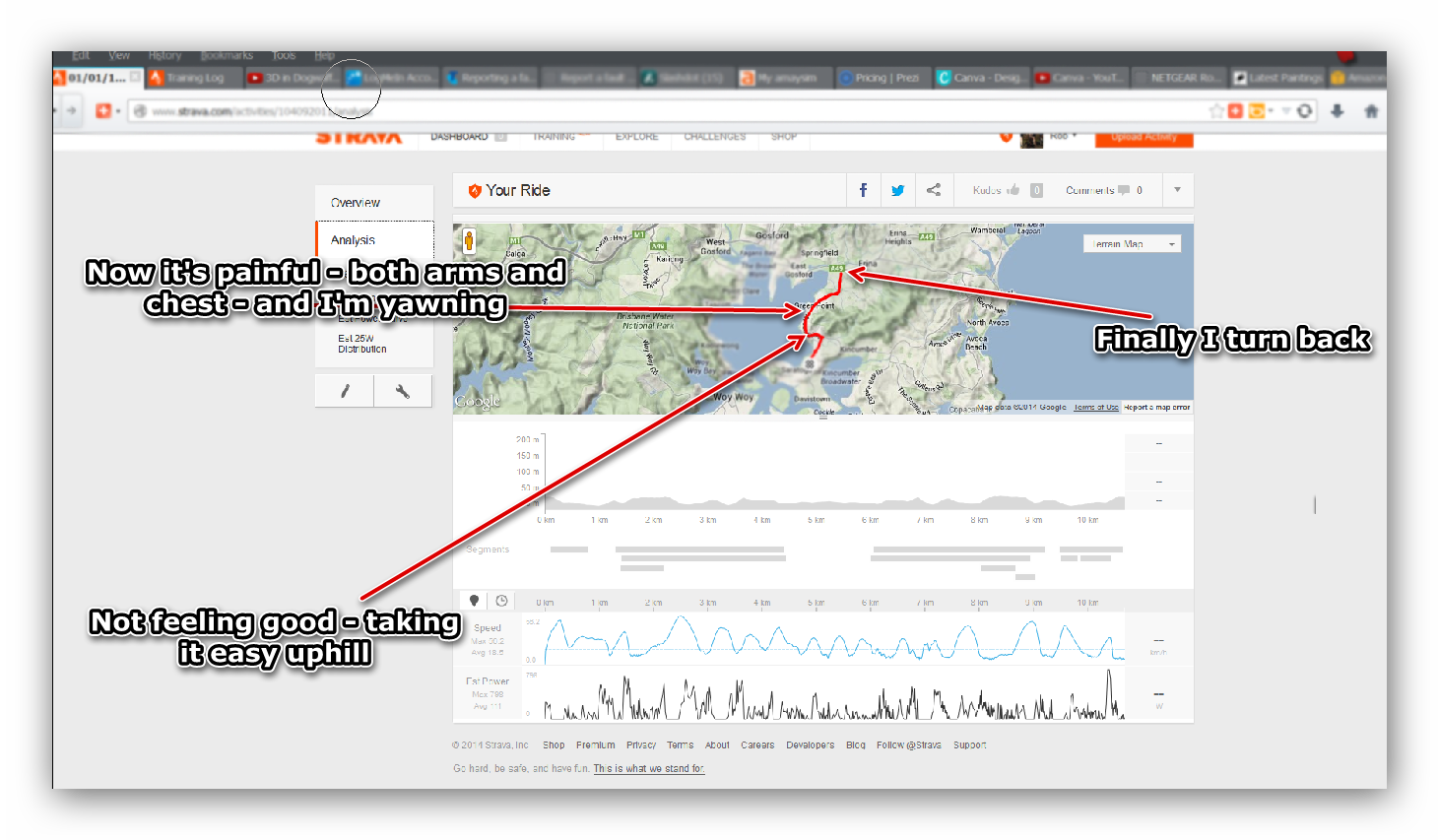

My original post on how it all happened. Plus some stats and other nonsense.
My original post on how it all happened. Plus some stats and other nonsense.
Did you want some pictures to go with that ischaemia, sir?
Did you read this: http://addicted2wheels.blogspot.com.au/2014/02/double-training-used-to-work-dont-let.html? Want to know more? Sure, how about some pics? No, not of the stents being inserted (although... now that I think about it, maybe tomorrow?) just some Strava screenshots of me having a "medical event" during a training ride....
It's fairly self-explanatory... 2013 wasn't a bad year for cycling but not great either. I peaked a couple of times with semi-decent months but got sick a few times that wrecked my race season (which turned out to be a good thing, maybe). I was playing catch-up all year. And then 2013 ended and 2014 went off with a bang (or a whimper perhaps)...
 Just another year? And then...
 One ride too many!
 I didn't feel well at all...
 And the figures prove it!
 'Creeping' is the word
 As I said, I ride a bit
 And I'm still riding!
 Hopefully I'll keep it up...
My original post on how it all happened. Some stats and other nonsense. And more.
It's fairly self-explanatory... 2013 wasn't a bad year for cycling but not great either. I peaked a couple of times with semi-decent months but got sick a few times that wrecked my race season (which turned out to be a good thing, maybe). I was playing catch-up all year. And then 2013 ended and 2014 went off with a bang (or a whimper perhaps)...
My original post on how it all happened. Some stats and other nonsense. And more.
Something else to add to my long list of broken bits!
Well I've never broken a gear hanger before... but by the glory of Felt I've done it now! (And I wasn't even changing gear - it just cracked and let go.) (This is a catch-up post, BTW.)
Monday, February 10, 2014
Double the training used to work. Now I'm not so sure. Or don't let age slow you down!
OK, so it 'used' to work. When I was 25 or so, anyway. Even when I was 35. But it started to go awry when I turned 42 or so. I'd always been relatively sensible in terms of avoiding over-training, making sure I ate right, or close anyway, and getting a bit of sleep. But the rules of thumb seemed to be breaking down. One moment all was well and consecutive 100km races on a weekend were fine, the next... not so good.
My rules of thumb? Number one, given a healthy diet and enough rest, is to train three times the distance of any given race per week, averaged over at least one month, preferably 3. After 3, back off, recover and build up again (preferably to a higher level). So if you want to race 100km, train at least 300km per week, average. That gives you base miles, basically. Build on that with specificity. I do have other rules of thumb but that's the main one.
Anyway, it worked for me until I was about 42 or so, but the signs of a problem were there from about 35, if I'd cared to look. I'd injure more easily. I couldn't mix-and-match sports as well as I used to (I was becoming highly cycling-specific but not entirely by choice!). And I was getting sick (mostly colds, mouth ulcers etc; irritants rather than 'show-stoppers') too often. And then it all went pear-shaped from my late 40s onwards. Now some of us will be luckier than others - some even less lucky than me - but my body reacted to aging by randomly mutating, as it were. It may have been stress-related, or environmental exposure to something I didn't even see. And it sent me on a medical-merry-go-round that hasn't ended.
But I persisted with training and racing, even if my racing suffered somewhat and became less frequent (I also had a young family, so was time-poor.) And that continued activity may have helped me fend off stage 2 of my medical maladies. Good aerobic fitness may well have protected me from the worst of my genetic (and perhaps dietary) failings. Which is to say that my heart attack at age 56 (whilst training, of course) was less severe than it may have been. And after 6 days off the bike I was back on - the trainer, anyway. A month or so later I am back on the road, feeling good - if a bit tentative.
What struck me down was high blood pressure, genetics and perhaps a love of dairy products. One coronary artery was significantly clogged and (since this was a new experience to me) I didn't recognise all of the early signs. Sure, I was 'treating' the high blood pressure with training (it works, up to a point, too). And I was still strong - still setting and re-setting Strava KOMs for example - but I became exhausted far too easily. There was no 'pain' as such, just lethargy and a feeling that I should 'go easy' today. Almost every day. At the time I put it down to all of the other medical issues I have collected (as you do) as well as "getting older". But when these new, sudden pains came I recognised immediately that although I had never experienced exactly this crushing sensation before, or the pain in both arms, I knew what the problem was: the heart. And I realised also that I had come 'close' to a similar feeling at the sharp end of a long sprint after a hard crit, several times. But unlike previous occasions I remained breathless and in pain, and it didn't go away. Not when I slowed down, nor even when I stopped.
Being both stupid and a cyclist (the 2 go hand-in-hand) I rode home with the pain, if rather slowly. I ran through some alternative options and even saw an ambulance and thought about flagging it down. I also remembered I had a mobile phone, my wife could pick me up in the car. Then again, I thought, maybe this is just an adverse reaction to the usual prescription medication I took this morning and it'll get better. Maybe I can just ride through this?
Oh yeah, and I live on a hill. My GPS data tells me it was the slowest I had ever ridden that hill, too. But I still wasn't the slowest. (Yes, I checked in Strava to be sure.) Although I knew with 90% certainty it was a heart attack I still wondered how I could ride home, uphill, whilst having an attack. Is that possible? And since I was averaging 200km/week I wondered how it was even possible that this could be happening at all. But it was.
The best part of 5 days in hospital and 3 stents have 'fixed' the clogged artery, now I just have to rebuild and get confident again. It takes time. So today's lesson? Don't think it can't happen. Cyclists - even long-time obsessively daily trainers like me - can have heart attacks. So be alert and react quickly and appropriately (like, stop riding and get medical help). Don't hesitate.
And yes, that daily training probably minimised the damage as well as fended off the day of the eventual heart attack itself. But listen to your body; if you aren't getting the training effect you used to get - and you are even going backwards - don't double the miles, instead take a rest or even have a chat with a doctor. It may just be over-training, lack of rest - or even an early warning sign of something far, far worse!
Some stats and other nonsense. And more.
My rules of thumb? Number one, given a healthy diet and enough rest, is to train three times the distance of any given race per week, averaged over at least one month, preferably 3. After 3, back off, recover and build up again (preferably to a higher level). So if you want to race 100km, train at least 300km per week, average. That gives you base miles, basically. Build on that with specificity. I do have other rules of thumb but that's the main one.
Anyway, it worked for me until I was about 42 or so, but the signs of a problem were there from about 35, if I'd cared to look. I'd injure more easily. I couldn't mix-and-match sports as well as I used to (I was becoming highly cycling-specific but not entirely by choice!). And I was getting sick (mostly colds, mouth ulcers etc; irritants rather than 'show-stoppers') too often. And then it all went pear-shaped from my late 40s onwards. Now some of us will be luckier than others - some even less lucky than me - but my body reacted to aging by randomly mutating, as it were. It may have been stress-related, or environmental exposure to something I didn't even see. And it sent me on a medical-merry-go-round that hasn't ended.
But I persisted with training and racing, even if my racing suffered somewhat and became less frequent (I also had a young family, so was time-poor.) And that continued activity may have helped me fend off stage 2 of my medical maladies. Good aerobic fitness may well have protected me from the worst of my genetic (and perhaps dietary) failings. Which is to say that my heart attack at age 56 (whilst training, of course) was less severe than it may have been. And after 6 days off the bike I was back on - the trainer, anyway. A month or so later I am back on the road, feeling good - if a bit tentative.
What struck me down was high blood pressure, genetics and perhaps a love of dairy products. One coronary artery was significantly clogged and (since this was a new experience to me) I didn't recognise all of the early signs. Sure, I was 'treating' the high blood pressure with training (it works, up to a point, too). And I was still strong - still setting and re-setting Strava KOMs for example - but I became exhausted far too easily. There was no 'pain' as such, just lethargy and a feeling that I should 'go easy' today. Almost every day. At the time I put it down to all of the other medical issues I have collected (as you do) as well as "getting older". But when these new, sudden pains came I recognised immediately that although I had never experienced exactly this crushing sensation before, or the pain in both arms, I knew what the problem was: the heart. And I realised also that I had come 'close' to a similar feeling at the sharp end of a long sprint after a hard crit, several times. But unlike previous occasions I remained breathless and in pain, and it didn't go away. Not when I slowed down, nor even when I stopped.
Being both stupid and a cyclist (the 2 go hand-in-hand) I rode home with the pain, if rather slowly. I ran through some alternative options and even saw an ambulance and thought about flagging it down. I also remembered I had a mobile phone, my wife could pick me up in the car. Then again, I thought, maybe this is just an adverse reaction to the usual prescription medication I took this morning and it'll get better. Maybe I can just ride through this?
Oh yeah, and I live on a hill. My GPS data tells me it was the slowest I had ever ridden that hill, too. But I still wasn't the slowest. (Yes, I checked in Strava to be sure.) Although I knew with 90% certainty it was a heart attack I still wondered how I could ride home, uphill, whilst having an attack. Is that possible? And since I was averaging 200km/week I wondered how it was even possible that this could be happening at all. But it was.
The best part of 5 days in hospital and 3 stents have 'fixed' the clogged artery, now I just have to rebuild and get confident again. It takes time. So today's lesson? Don't think it can't happen. Cyclists - even long-time obsessively daily trainers like me - can have heart attacks. So be alert and react quickly and appropriately (like, stop riding and get medical help). Don't hesitate.
And yes, that daily training probably minimised the damage as well as fended off the day of the eventual heart attack itself. But listen to your body; if you aren't getting the training effect you used to get - and you are even going backwards - don't double the miles, instead take a rest or even have a chat with a doctor. It may just be over-training, lack of rest - or even an early warning sign of something far, far worse!
Some stats and other nonsense. And more.
Wednesday, July 24, 2013
1998 was a while ago - do we care? Probably.
It would be nice to have a complete picture of doping in sport - all sports - globally but the truth is that it'll never happen. It's too hard, the data is lost or incomplete. Nevertheless when we have the chance to peek back at the past the temptation is hard to resist... but at the end of the day, should we care?
"Italian Marco Pantani, Germany's Jan Ullrich and American Bobby Julich who were the top three during the 1998 Tour de France were all taking the banned blood booster erythropoetin (EPO), according to reports published by French daily Le Monde."
News: Cycling Central SBS
The samples in question are old but the test is probably valid. Worth noting that Pantani is not around to defend himself.
"Italian Marco Pantani, Germany's Jan Ullrich and American Bobby Julich who were the top three during the 1998 Tour de France were all taking the banned blood booster erythropoetin (EPO), according to reports published by French daily Le Monde."
News: Cycling Central SBS
The samples in question are old but the test is probably valid. Worth noting that Pantani is not around to defend himself.
Monday, July 08, 2013
The power of planned chaos - Le Tour 2013 week 1
It's been an interesting - indeed fascinating - week 1. Usually (in recent experience, anyway, as nothing is truly set in stone) Le Tour starts with a prologue that sorts the riders into something like a sprinter-heavy pecking order, followed by a few flat stages where the the sprinters swap the yellow jersey amongst themselves. Instead we got a longish and unexpectedly confused stage 1 that mixed things up a bit more than usual, and a team time trial that threw up some surprises and pushed the GC guys up and down in unexpected ways. The result was that one or 2 GC teams (including BMC) were almost out of the main game already. And then the first mountain stage (stage 8) tipped the bucket on a few more teams - most of them, actually. It looked like Sky had sewn it up already. Or so it seemed.
But in stage 9 the ever-creative Garmin team threw caution to the wind and attacked from the gun, shattering Sky's calm, possibly forever. In hindsight it was predictable. Froome's wilful, ungainly and somewhat brazen attack to grab the golden fleece always seemed premature but given Sky's dominance last year most people just expected it. Of course it will be a Sky 1-2 and of course they can hold off all comers from here. Or not, perhaps.
Two thoughts flashed through my mind as Froome took off: 'he's gone too soon, week 3 is where he should do this, if he still can'; and 'my god this looks bad - he not only rides without any style (not a problem for 2nd placed Richie Porte, though) but he looks crazed, in the worst possible 'extraterrestrial' way. Actually 3 thoughts, as I also feared for the race from here if Sky dominate crushingly like last year. As in boring. I shouldn't have worried, though, as whilst Froome still looks ungainly he can obviously defend as well as attack, and Porte (as well as the rest of the Sky team) proved fallibly human. Thankfully.
Of course Sky were aided in their less than perfect stage 9 by an agressive Movistar team taking no prisoners. If only they had a couple more Columbians to drive home the advantage they worked so hard to gain. Mind you the lack of attacks reinforced the "it's only the first week" voice inside my head and calmed the 'extraterriestrial' thoughts. They look human, and un-doped. Just. And unlike stage 8 the usual GC suspects were able to hang in there, reassuringly.
But what really impressed me was Garmin attacking from the blocks, gloriously oblivious to both Sky and 5 tough mountain climbs to come. Thank you, JV and team for that come-from-behind with a run-up approach. It made the week passably brilliant.
"We were attacking without thinking about it, it was crazy," Martin told a news conference after the 168.5-km from St Girons."We wanted to make the race exciting. We enjoy bike riding, we wanted to put on a show for people at home." Garmin-Sharp's laid-back attitude is in sharp contrast with Team Sky's clinical approach but on Sunday they had a strategy.
"This stage was a bit of an objective for us since the start in Corsica and even after having lost Christian Vande Velde," Martin said, referring to the crash on stage seven that ruled his team-mate out of the Tour."It was a stage that suited us. With the team we have we can afford to be aggressive."
Martin is a decent climber, just like Danielson and Hesjedal, and they stuck to manager Jonathan Vaughters' plan to "cause chaos" in the race. "Craziest thing about today? We planned it," said Millar.
News: Cycling Central SBS
But in stage 9 the ever-creative Garmin team threw caution to the wind and attacked from the gun, shattering Sky's calm, possibly forever. In hindsight it was predictable. Froome's wilful, ungainly and somewhat brazen attack to grab the golden fleece always seemed premature but given Sky's dominance last year most people just expected it. Of course it will be a Sky 1-2 and of course they can hold off all comers from here. Or not, perhaps.
Two thoughts flashed through my mind as Froome took off: 'he's gone too soon, week 3 is where he should do this, if he still can'; and 'my god this looks bad - he not only rides without any style (not a problem for 2nd placed Richie Porte, though) but he looks crazed, in the worst possible 'extraterrestrial' way. Actually 3 thoughts, as I also feared for the race from here if Sky dominate crushingly like last year. As in boring. I shouldn't have worried, though, as whilst Froome still looks ungainly he can obviously defend as well as attack, and Porte (as well as the rest of the Sky team) proved fallibly human. Thankfully.
Of course Sky were aided in their less than perfect stage 9 by an agressive Movistar team taking no prisoners. If only they had a couple more Columbians to drive home the advantage they worked so hard to gain. Mind you the lack of attacks reinforced the "it's only the first week" voice inside my head and calmed the 'extraterriestrial' thoughts. They look human, and un-doped. Just. And unlike stage 8 the usual GC suspects were able to hang in there, reassuringly.
But what really impressed me was Garmin attacking from the blocks, gloriously oblivious to both Sky and 5 tough mountain climbs to come. Thank you, JV and team for that come-from-behind with a run-up approach. It made the week passably brilliant.
"We were attacking without thinking about it, it was crazy," Martin told a news conference after the 168.5-km from St Girons."We wanted to make the race exciting. We enjoy bike riding, we wanted to put on a show for people at home." Garmin-Sharp's laid-back attitude is in sharp contrast with Team Sky's clinical approach but on Sunday they had a strategy.
"This stage was a bit of an objective for us since the start in Corsica and even after having lost Christian Vande Velde," Martin said, referring to the crash on stage seven that ruled his team-mate out of the Tour."It was a stage that suited us. With the team we have we can afford to be aggressive."
Martin is a decent climber, just like Danielson and Hesjedal, and they stuck to manager Jonathan Vaughters' plan to "cause chaos" in the race. "Craziest thing about today? We planned it," said Millar.
News: Cycling Central SBS
Thursday, May 16, 2013
What really makes a difference to your race performance?
It depends of course on your level of achievement and current fitness, bike fit, diet, health and equipment.
If you have a dodgy bike that weighs a ton and threatens to fall to bits at any second - there's your priority. But if you have a decent bike - say 9kgs or so, made of any popular material and completely safe and serviceable then for 99% of us upgrading won't make much, if any, difference. If it does make a measurable difference - and it's hard to really measure these things - it'll most likely be a head gain, not an equipment-specific improvement.
Not convinced? Well then, in terms of bike improvements aim to reduce rotating mass - starting with the wheels. That is something you'll feel immediately in improved acceleration. You want stiffness? Again, look to the wheels. You'll feel that, too. But weight and frame stiffness overall is of little consequence - except at the sharp end of the elite ranks. Unless you race at that sharp end, why would you pay an extra few thousand dollars simply to reduce your bike by just a kilo or 2? Or stiffen up what is already a remarkably stiff triangle of steel, aluminium or carbon? It simply won't make a difference, except you'll maybe feel and perhaps look cooler in the bunch. Perhaps that matters. Or maybe not!
Maybe lose some weight yourself. After all it's you that weighs the most in this equation. Bike, 9kg or so. Rider? Perhaps you weigh 80kg with say 20-25% fat onboard (not that unusual, even with fit, fast guys). Imagine how much less effort you'll need to ride fast(er) if you dropped just a few kilos off yourself? It's all about power to weight, and improving your power without dropping some weight is just addressing half the problem. Look to achieve 12% body fat or slightly less (a lot less at elite levels) but don't go silly with diets or do dodgy things. Talk with a doctor or nutritionist if in any doubt. Eat a bit less, ride a bit more.
But if power is lacking, try intervals. Repeated hill intervals or hill sprints (150-200m hillclimbs in a biggish gear but still turning easily - don't grind!) will pick your power up nicely. Balance and consistency are the keys here. Don't just do one thing over and over - you'll get tired, probably over-tired, and become a one-trick pony. Mix it up both on a single training ride and from ride to ride.
Mix in some endurance, some power work and some speed work. And get in a bunch once in a while to get speed and endurance up quickly in tandem with your bunch riding skills. And be consistent. Don't do a single big ride and then not do another for a month or more. You'll lose what you gained.
Make a plan and stick as closely as you can to it, injuries aside. You need to do long rides, perhaps for an endurance event? Then build up with lots of shorter endurance rides for a month or 2, get used to doing lots of miles in a week but not in one go. Then add those much longer rides in later. But repeat them weekly so your body "remembers". So you'll end up with regular, shorter rides dotted through the week and a bigger ride or race once or maybe twice a week. And build the whole thing up gradually and incrementally to avoid injury and form loss.
Remember to be consistent, as in a pattern of repeated behaviour, because that tells your body to adjust to that expected effort. Inconsistency sends a confused message to your body and you'll get a confused response. Throw in speed work and power efforts as well but don't over-train. And plan your rests, too. A good training plan builds gradually, reaches a new level and then eases off before climbing to new heights in the next phase. You need to recover - not stop, just ease off - before aiming higher in power or endurance, or both.
More to come, I'm sure ;-)
If you have a dodgy bike that weighs a ton and threatens to fall to bits at any second - there's your priority. But if you have a decent bike - say 9kgs or so, made of any popular material and completely safe and serviceable then for 99% of us upgrading won't make much, if any, difference. If it does make a measurable difference - and it's hard to really measure these things - it'll most likely be a head gain, not an equipment-specific improvement.
Not convinced? Well then, in terms of bike improvements aim to reduce rotating mass - starting with the wheels. That is something you'll feel immediately in improved acceleration. You want stiffness? Again, look to the wheels. You'll feel that, too. But weight and frame stiffness overall is of little consequence - except at the sharp end of the elite ranks. Unless you race at that sharp end, why would you pay an extra few thousand dollars simply to reduce your bike by just a kilo or 2? Or stiffen up what is already a remarkably stiff triangle of steel, aluminium or carbon? It simply won't make a difference, except you'll maybe feel and perhaps look cooler in the bunch. Perhaps that matters. Or maybe not!
Maybe lose some weight yourself. After all it's you that weighs the most in this equation. Bike, 9kg or so. Rider? Perhaps you weigh 80kg with say 20-25% fat onboard (not that unusual, even with fit, fast guys). Imagine how much less effort you'll need to ride fast(er) if you dropped just a few kilos off yourself? It's all about power to weight, and improving your power without dropping some weight is just addressing half the problem. Look to achieve 12% body fat or slightly less (a lot less at elite levels) but don't go silly with diets or do dodgy things. Talk with a doctor or nutritionist if in any doubt. Eat a bit less, ride a bit more.
But if power is lacking, try intervals. Repeated hill intervals or hill sprints (150-200m hillclimbs in a biggish gear but still turning easily - don't grind!) will pick your power up nicely. Balance and consistency are the keys here. Don't just do one thing over and over - you'll get tired, probably over-tired, and become a one-trick pony. Mix it up both on a single training ride and from ride to ride.
Mix in some endurance, some power work and some speed work. And get in a bunch once in a while to get speed and endurance up quickly in tandem with your bunch riding skills. And be consistent. Don't do a single big ride and then not do another for a month or more. You'll lose what you gained.
Make a plan and stick as closely as you can to it, injuries aside. You need to do long rides, perhaps for an endurance event? Then build up with lots of shorter endurance rides for a month or 2, get used to doing lots of miles in a week but not in one go. Then add those much longer rides in later. But repeat them weekly so your body "remembers". So you'll end up with regular, shorter rides dotted through the week and a bigger ride or race once or maybe twice a week. And build the whole thing up gradually and incrementally to avoid injury and form loss.
Remember to be consistent, as in a pattern of repeated behaviour, because that tells your body to adjust to that expected effort. Inconsistency sends a confused message to your body and you'll get a confused response. Throw in speed work and power efforts as well but don't over-train. And plan your rests, too. A good training plan builds gradually, reaches a new level and then eases off before climbing to new heights in the next phase. You need to recover - not stop, just ease off - before aiming higher in power or endurance, or both.
More to come, I'm sure ;-)
Wednesday, May 15, 2013
Is training really all about periodization, intervals and power?
Well, no, training is about everything. It's about your effort on the bike plus nutrition, sleep, rest and your mental state, too - ie everything. It's even a little about the bike, as well.
But we can get carried away with the details and forget to just ride. To have fun.
I think we all have friends who are a bit unbalanced in their training. They obsess about some aspects - usually the hardware but sometimes also about diet or technique - and forget to just get out and ride. They may even rush out and engage a coach before even attempting the basics - like just riding regularly. They tie themselves in knots trying to meet goals that are way above where their bodies are at and get consumed by the details rather than look at the big picture. Phew. You know the type, right?
So I thought I'd write something about training with a non-technical slant. Mostly for the beginner, but for anyone really: it's Rob's "Just ride" training plan.
Remember - start healthy, stay healthy. If you are really new to exercise or have any doubts at all, see a doctor first.
Now, just ride (obviously). Don't race at first. Don't do intervals or baseline efforts. It's a mistake to do intervals, hill training or big rides without building a regular, consistent base first. Just ride regularly several times a week and well within your ability. If you want to race it's all built on experience and miles in the saddle. Your body adjusts over time to what you do in life, so if you are riding lots then your body adjusts to that effort. You get used to it. Just be consistent and do it because you love it. Join a club, ride with others. Learn by doing.
But you plan to race, yes? Sure, but you certainly don't have to do mega-miles or special efforts at this stage. Unscientific Rule of Thumb Number 1 works for me: if you plan to race then ride at least 3 times that distance in training per week, on average. No intervals, nothing fancy, just ride. So if you plan to race 50km just plan to train 150km a week, minimum. Yes you can do it with a lot less - but in the back of your mind you'll be thinking 'have I done enough?' And the answer will be 'no'. Don't race until you hit - or at least approach - that goal!
Unscientific Rule of Thumb Number 2 is that you need to build up gradually - don't just leap on a bike and ride 150km in one go and say "job done!". That's cheating and it doesn't work, at least for most of us! And it can (perhaps will) lead to injury. Instead make a plan to reach 150km a week (or whatever) in a series of incremental steps. 2 to 3 months is a good period over which to build up. Your body and mind will adjust to the effort and is less likely to break. But if you do get sore, slow down a bit or rest. Take some time to build a base. And don't race unless you have met your training goals first.
Unscientific Rule of Thumb Number 3 is similar to 2, it's "be consistent". Take breaks or ease off if your body says "rest" or "oww" but always come back to a repeatable pattern of effort that works for you. So ditch the "big ride" syndrome (at least for now, we can come back to that later) and go for regular, shorter efforts. One big ride per week works for some of us but mostly it's inefficient and ineffective. A better way to train is to do shorter daily or every-2nd-day efforts. So your 150km training week may be 3x50km rides or one 50km race and 5x20km efforts during the week. This allows your body (and mind) time to recover whilst ensuring that gains are made. If you are inconsistent, however, and do irregular big rides to "catch-up" you simply don't make the same incremental gains and risk injury.
Unscientific Rule of Thumb Number 4 is "when you have done the miles, build on it". If you have followed what I have written so far you will have set out an achievable plan, adjusted it as needed, achieved it and done your consistent base miles. You may now race with some confidence. Of course a newbie will still struggle as we haven't covered intervals, power training and basic race skills and tactics. But that's the beauty of it all - you get to incorporate what you learn into your dynamic training plan! This is the build phase. You build in efforts that address weaknesses and enhance strengths. Now if you are a newbie to racing then be open to learn as it does involve a lot of skills, rules and etiquette that are not immediately obvious. Again, join a club, ride with others to get that experience.
So the build phase is literally built on a solid, consistent, regular and repeated base of steady miles. Not an on-and-off, patchy, lots-of-days-off melange of commutes peppered with massive catch-up rides. Unscientific Rule of Thumb Number 5 tells us that you lose "some" form and fitness - it varies from person to person and by age so let's just say "some" - after only 2 days off the bike. You keep most, sure, but you lose 'something'. It may be small but after 2 days a bit of what you just gained is lost again. But if you leave 4 days or more between rides then you lose a much bigger slice of whatever you last gained. Again it's not all lost but it's certainly not all there, either. (Cautionary note - sometimes you just have to rest and recover, treat an injury or whatever and simply must take days off. It happens, it's OK.)
In summary, your body simply doesn't waste resources. If it looks like you won't be using those muscles and endurance power systems again, rather than keep it "just in case" it redistributes those resources elsewhere. Hence regularity and consistency are king, they remind your body of what you need to do.
Now with the base in place you can add the fancy stuff to build speed, power and endurance. If you really enjoy it and want to take it further you can read up or get a coach. And remember: have fun.
But we can get carried away with the details and forget to just ride. To have fun.
I think we all have friends who are a bit unbalanced in their training. They obsess about some aspects - usually the hardware but sometimes also about diet or technique - and forget to just get out and ride. They may even rush out and engage a coach before even attempting the basics - like just riding regularly. They tie themselves in knots trying to meet goals that are way above where their bodies are at and get consumed by the details rather than look at the big picture. Phew. You know the type, right?
So I thought I'd write something about training with a non-technical slant. Mostly for the beginner, but for anyone really: it's Rob's "Just ride" training plan.
Remember - start healthy, stay healthy. If you are really new to exercise or have any doubts at all, see a doctor first.
Now, just ride (obviously). Don't race at first. Don't do intervals or baseline efforts. It's a mistake to do intervals, hill training or big rides without building a regular, consistent base first. Just ride regularly several times a week and well within your ability. If you want to race it's all built on experience and miles in the saddle. Your body adjusts over time to what you do in life, so if you are riding lots then your body adjusts to that effort. You get used to it. Just be consistent and do it because you love it. Join a club, ride with others. Learn by doing.
But you plan to race, yes? Sure, but you certainly don't have to do mega-miles or special efforts at this stage. Unscientific Rule of Thumb Number 1 works for me: if you plan to race then ride at least 3 times that distance in training per week, on average. No intervals, nothing fancy, just ride. So if you plan to race 50km just plan to train 150km a week, minimum. Yes you can do it with a lot less - but in the back of your mind you'll be thinking 'have I done enough?' And the answer will be 'no'. Don't race until you hit - or at least approach - that goal!
Unscientific Rule of Thumb Number 2 is that you need to build up gradually - don't just leap on a bike and ride 150km in one go and say "job done!". That's cheating and it doesn't work, at least for most of us! And it can (perhaps will) lead to injury. Instead make a plan to reach 150km a week (or whatever) in a series of incremental steps. 2 to 3 months is a good period over which to build up. Your body and mind will adjust to the effort and is less likely to break. But if you do get sore, slow down a bit or rest. Take some time to build a base. And don't race unless you have met your training goals first.
Unscientific Rule of Thumb Number 3 is similar to 2, it's "be consistent". Take breaks or ease off if your body says "rest" or "oww" but always come back to a repeatable pattern of effort that works for you. So ditch the "big ride" syndrome (at least for now, we can come back to that later) and go for regular, shorter efforts. One big ride per week works for some of us but mostly it's inefficient and ineffective. A better way to train is to do shorter daily or every-2nd-day efforts. So your 150km training week may be 3x50km rides or one 50km race and 5x20km efforts during the week. This allows your body (and mind) time to recover whilst ensuring that gains are made. If you are inconsistent, however, and do irregular big rides to "catch-up" you simply don't make the same incremental gains and risk injury.
Unscientific Rule of Thumb Number 4 is "when you have done the miles, build on it". If you have followed what I have written so far you will have set out an achievable plan, adjusted it as needed, achieved it and done your consistent base miles. You may now race with some confidence. Of course a newbie will still struggle as we haven't covered intervals, power training and basic race skills and tactics. But that's the beauty of it all - you get to incorporate what you learn into your dynamic training plan! This is the build phase. You build in efforts that address weaknesses and enhance strengths. Now if you are a newbie to racing then be open to learn as it does involve a lot of skills, rules and etiquette that are not immediately obvious. Again, join a club, ride with others to get that experience.
So the build phase is literally built on a solid, consistent, regular and repeated base of steady miles. Not an on-and-off, patchy, lots-of-days-off melange of commutes peppered with massive catch-up rides. Unscientific Rule of Thumb Number 5 tells us that you lose "some" form and fitness - it varies from person to person and by age so let's just say "some" - after only 2 days off the bike. You keep most, sure, but you lose 'something'. It may be small but after 2 days a bit of what you just gained is lost again. But if you leave 4 days or more between rides then you lose a much bigger slice of whatever you last gained. Again it's not all lost but it's certainly not all there, either. (Cautionary note - sometimes you just have to rest and recover, treat an injury or whatever and simply must take days off. It happens, it's OK.)
In summary, your body simply doesn't waste resources. If it looks like you won't be using those muscles and endurance power systems again, rather than keep it "just in case" it redistributes those resources elsewhere. Hence regularity and consistency are king, they remind your body of what you need to do.
Now with the base in place you can add the fancy stuff to build speed, power and endurance. If you really enjoy it and want to take it further you can read up or get a coach. And remember: have fun.
Tuesday, May 14, 2013
Does pre-race carbo loading really work?
Let's face it, most of like to eat. Many of us like to eat a lot. And "carbo-loading" before a race seems like a really, really good excuse to do exactly that - pig out, guilt-free. But is it?
I have to say I've tried it a few times and it hasn't really worked. I've mostly done it in (short, amateur!) stage races or before a big road race. My performance didn't improve - seemingly, because how could I really tell? I didn't endure any better and I spent more time on the loo both pre and post race. But I did it in the '80s and the science has moved on, presumably.
The theory's good, though. In my day (the '80s, like I said) a few days to a week beforehand I'd ride to exhaustion a few days in a row - and I do mean exhaustion - whilst cutting back the carbs. And then I'd 'over-recover' for a few more days by backing off the miles, resting, and ingesting more than enough carbs than strictly necessary to simply refuel. Anecdotally this is still a popular idea - you 'fly' a few days after riding yourself into the ground. Somehow - this is the dodgy bit in my opinion - the body not only takes on what it needs it adds a bit more as a gluttony bonus, as though it senses you are about to do something extreme, or maybe even stoopid. But how does it know (insert something plausible about stimulating glycogen synthase here)?
And why would we evolve such a curious turbo-boost function? It doesn't seem likely, really, does it? If you over-eat you should simply egest or store (as fat) what you don't have room to conserve. Why would there be a secret hidey-hole for extra carbs?
Of course it's possible that waves of feast and famine coupled with our ancient mania for endurance walking have set this up for us. It's possible.
So much for the good old days. These days sports scientists generally believe it does work, even if it's just via the placebo effect (and who cares, as long as it works?). And they have generally ditched the ride-to-exhaustion bit. Rather you just do the diet and rest bit. (Which sounds a bit too convenient for me, but anyway...). The theory remains that training less ('tapering') but eating more carbs (ie eating more low-fat sugar and starch but slightly less protein and even less fibre) over 1-4 days will measurably boost your available muscle glycogen levels before an event. So it does work, indeed it just sounds like resting and recovery to me - and it's even easier than ever. But remember it's still not a licence to pig out!
I have to say I've tried it a few times and it hasn't really worked. I've mostly done it in (short, amateur!) stage races or before a big road race. My performance didn't improve - seemingly, because how could I really tell? I didn't endure any better and I spent more time on the loo both pre and post race. But I did it in the '80s and the science has moved on, presumably.
The theory's good, though. In my day (the '80s, like I said) a few days to a week beforehand I'd ride to exhaustion a few days in a row - and I do mean exhaustion - whilst cutting back the carbs. And then I'd 'over-recover' for a few more days by backing off the miles, resting, and ingesting more than enough carbs than strictly necessary to simply refuel. Anecdotally this is still a popular idea - you 'fly' a few days after riding yourself into the ground. Somehow - this is the dodgy bit in my opinion - the body not only takes on what it needs it adds a bit more as a gluttony bonus, as though it senses you are about to do something extreme, or maybe even stoopid. But how does it know (insert something plausible about stimulating glycogen synthase here)?
And why would we evolve such a curious turbo-boost function? It doesn't seem likely, really, does it? If you over-eat you should simply egest or store (as fat) what you don't have room to conserve. Why would there be a secret hidey-hole for extra carbs?
Of course it's possible that waves of feast and famine coupled with our ancient mania for endurance walking have set this up for us. It's possible.
So much for the good old days. These days sports scientists generally believe it does work, even if it's just via the placebo effect (and who cares, as long as it works?). And they have generally ditched the ride-to-exhaustion bit. Rather you just do the diet and rest bit. (Which sounds a bit too convenient for me, but anyway...). The theory remains that training less ('tapering') but eating more carbs (ie eating more low-fat sugar and starch but slightly less protein and even less fibre) over 1-4 days will measurably boost your available muscle glycogen levels before an event. So it does work, indeed it just sounds like resting and recovery to me - and it's even easier than ever. But remember it's still not a licence to pig out!
Now that was the Giro for me - coffee breaks and all
Jose Azevedo states the obvious - the Giro isn't the Tour - but it's getting more similar. What I really like is his 'back in my day' reflection:
"Back when I raced the Giro, on the flat stages a break would go early on, then we'd all ease back and ride very, very gently until about 50 kilometres to go," he said.
"A lot of days, the main bunch would even have cappuccino and cake or ice cream stops mid-race in some of the villages.
Now that's a bike race.
Unpredictable Giro tests riders, staff : SBS Cycling Central | Cycling News and Results | Video Highlights
"Back when I raced the Giro, on the flat stages a break would go early on, then we'd all ease back and ride very, very gently until about 50 kilometres to go," he said.
"A lot of days, the main bunch would even have cappuccino and cake or ice cream stops mid-race in some of the villages.
Now that's a bike race.
Unpredictable Giro tests riders, staff : SBS Cycling Central | Cycling News and Results | Video Highlights
Monday, May 13, 2013
Evans and Wurf now lead Points and Sprints at Giro D'Italia 2013: Stage 9 Results | Cyclingnews.com
Ahh, the Grand Tours. It's just interesting - no, fascinating - to watch the steady, incremental progress that Cadel Evans is quietly making in this Giro. Nothing too flash, but he is relentlessly picking up bunch sprints and high placings, leading to the steady collection of points in the, umm, points classification. No surprise really, it's his style as a "GC guy" to take what's available as it presents.
If he has a plan it's to stay close, match Nibali and the less-impressive-so-far Wiggins and keep on keeping on. Perhaps he will attack on a climb when or if Nibali shows weakness? Or wait until the uphill chrono in week 3? Or just wait, period. It's only the end of the first week after all.
Wurf meanwhile is hanging on in the sprint category (a bit of a misnomer really) through consistency and grit and right-place-right-time methodology. Hansen of course has won a stage so he's happy!
Giro D'Italia 2013: Stage 9 Results | Cyclingnews.com
If he has a plan it's to stay close, match Nibali and the less-impressive-so-far Wiggins and keep on keeping on. Perhaps he will attack on a climb when or if Nibali shows weakness? Or wait until the uphill chrono in week 3? Or just wait, period. It's only the end of the first week after all.
Wurf meanwhile is hanging on in the sprint category (a bit of a misnomer really) through consistency and grit and right-place-right-time methodology. Hansen of course has won a stage so he's happy!
Giro D'Italia 2013: Stage 9 Results | Cyclingnews.com
Wednesday, January 09, 2013
Maxxis tyre go boom!

There's something about summer and bike tyres and Central Coast roads I guess. Last year (or maybe it was 2011, I don't care anymore) saw a huge bubble form on a Vittoria road clincher, so bad that eventually it was hitting the brake with every revolution. Whilst it was sensible to stop anyway, it was annoying, just 3 km short of home.
It was another hot day and another brand of tyre - Maxxis Detonator, would you believe! - that saw this bubble-and-split occur. Same road, though, and neither tyre was over-inflated, BTW. And I have ridden hot roads before without such incident.
At least this time I made it all the way home, cautiously. Are tyres just getting worse in this bubble-and-split respect?
Friday, November 09, 2012
Down but not out - first Wiggo, now Sutton hit in UK traffic
It can happen anywhere. I don't know how it happened, but it happened. I used to ride at the other end of the St George bunch from Shane, hanging on grimly or chasing back on, and whilst he was always a volatile guy he wasn't stupid. Accidents happen. Road design aside, it's vital that all riders, pedestrians and drivers are careful, awake amd aware out there.
British Cycling coach Shane Sutton hospitalized after collision with auto
British Cycling coach Shane Sutton hospitalized after collision with auto
Commenting on the bizarre timing of the two accidents, British Cycling wrote, “”It is extremely rare that our riders and coaches are hurt while out cycling on the road, even rarer that two incidents should occur in a short space of time, and we wish Shane and Bradley a speedy recovery.”
The federation also called on the government to put cycling “at the heart of transport policy to ensure that cycle safety is built into the design of all new roads, junctions and transport projects, rather than being an afterthought.”
Subscribe to:
Posts (Atom)